
If your UK business website still hasn't fully addressed Core Web Vitals, 2026 is the year the gap between optimised and unoptimised sites will become impossible to ignore. Google has continued to refine its page experience signals, and the businesses that invest in technical performance are consistently outranking, outconverting, and outperforming those that don't. At STEPS Solutions, our web development and SEO teams in Halifax, West Yorkshire work with UK businesses of every size — and the pattern is clear: sites that score well on Core Web Vitals attract more organic traffic, retain more visitors, and generate more leads. This guide breaks down exactly what Core Web Vitals mean in 2026, what's changed, and what your site must get right to compete.

What Are Core Web Vitals and Why Do They Matter in 2026?
Core Web Vitals are a set of specific, measurable metrics defined by Google to quantify real-world user experience on web pages. They form a critical component of Google's page experience ranking signals, directly influencing how your site ranks in search results.
In 2026, three Core Web Vitals remain central to Google's evaluation framework:
- LCP (Largest Contentful Paint) — measures loading performance. A good score is under 2.5 seconds.
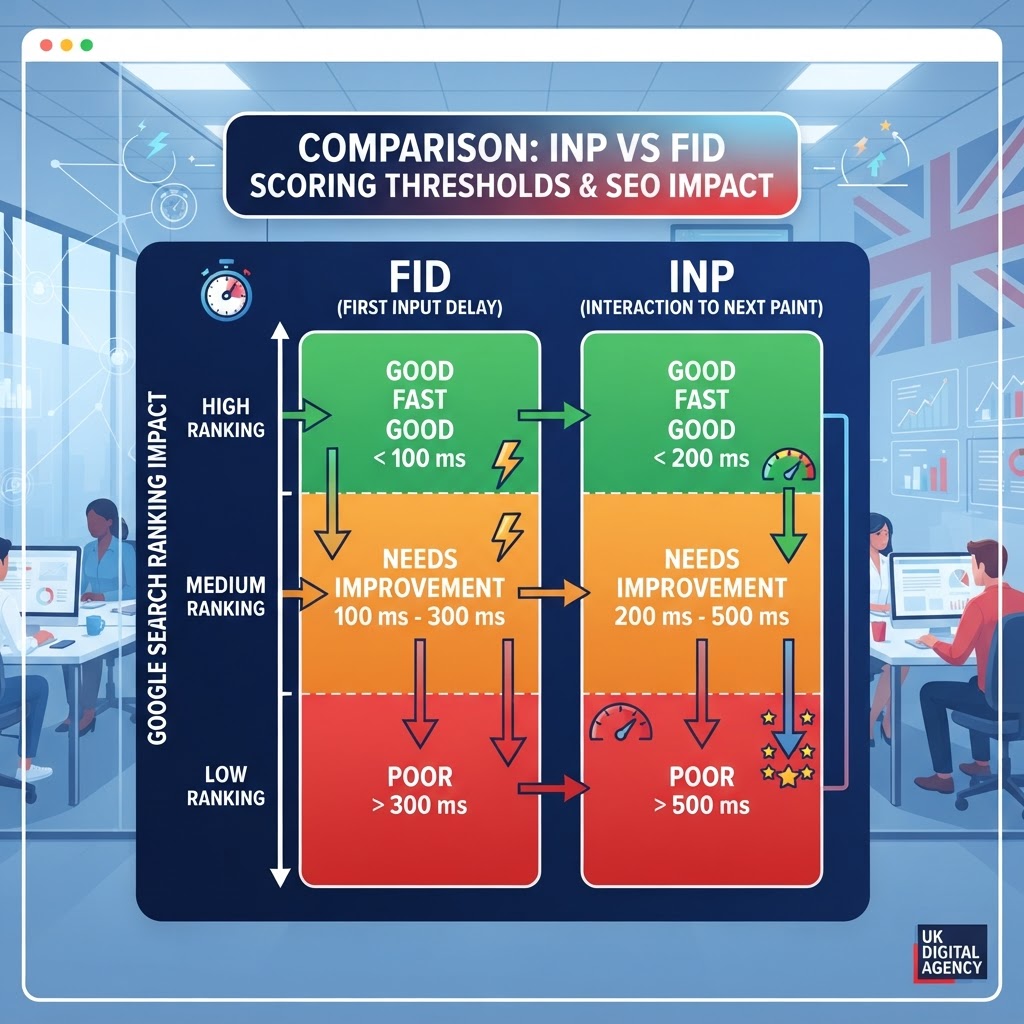
- INP (Interaction to Next Paint) — replaced FID in March 2024, measuring overall interactivity and responsiveness. A good score is under 200 milliseconds.
- CLS (Cumulative Layout Shift) — measures visual stability. A good score is under 0.1.
These aren't abstract technical scores. They reflect how real users experience your site on real devices, including the ageing Android smartphones and variable 4G connections common across Yorkshire and the wider UK. Poor scores translate directly into higher bounce rates and lost conversions.
"Sites that pass all three Core Web Vitals thresholds see a 24% lower abandonment rate compared to those that fail — a statistic with direct commercial implications for any UK business investing in organic search." — Google Search Central Research, 2024
What Changed: INP Replaces FID and What It Means for Your Site
The most significant technical shift in recent Core Web Vitals history was the replacement of First Input Delay (FID) with Interaction to Next Paint (INP) in March 2024. By 2026, every site should be fully optimised around INP — yet many UK business websites are still configured around the old FID benchmark.
Why INP Is Harder to Pass Than FID
FID only measured the delay before the browser began processing the very first user interaction. INP measures the latency of all interactions throughout a page visit — clicks, taps, keyboard inputs — and reports the worst-case result. This is a far stricter and more representative measure of how sluggish a site feels during normal browsing.
Common causes of poor INP scores include:
- Heavy JavaScript bundles blocking the main thread
- Third-party scripts (chat widgets, analytics, ad trackers) executing synchronously
- Unoptimised event handlers on interactive elements
- WordPress plugins adding unnecessary render-blocking code
- Poorly implemented animations and UI transitions
For UK businesses running WooCommerce stores, membership sites, or content-heavy WordPress builds, INP is frequently the metric that triggers a failing page experience score. This is an area where the STEPS Solutions development team consistently identifies quick wins during technical SEO audits.
LCP Optimisation: Making Your Pages Load Fast Enough to Rank
Largest Contentful Paint remains the metric most directly connected to perceived page speed. It marks the point at which the largest visible content element — typically a hero image, heading, or video thumbnail — has fully loaded. Google wants to see this happen in under 2.5 seconds from the moment a user navigates to your page.
Practical Steps to Improve LCP in 2026
- Serve images in next-generation formats — WebP and AVIF files are significantly smaller than JPEG or PNG equivalents without visible quality loss.
- Use a Content Delivery Network (CDN) — serving assets from servers geographically closer to your UK visitors reduces time-to-first-byte (TTFB), a key LCP dependency.
- Preload your LCP resource — use
<link rel="preload">to tell the browser to fetch the LCP image as early as possible. - Eliminate render-blocking resources — defer non-critical CSS and JavaScript so the browser can paint content faster.
- Optimise your hosting environment — shared hosting with poor server response times is one of the most common causes of LCP failures for UK small business websites.
A well-optimised LCP doesn't just help with rankings. It creates the immediate first impression of a fast, professional business — something particularly important for local service businesses in competitive markets across Halifax, Leeds, Manchester, and beyond.
CLS: The Silent Conversion Killer Hiding on UK Business Websites
Cumulative Layout Shift is the most misunderstood of the three Core Web Vitals. It measures how much page content unexpectedly moves around as the page loads — the frustrating experience of going to click a button only for it to jump down the screen as an ad or image loads above it.
A CLS score above 0.1 signals a poor user experience, and Google penalises it accordingly. The most common CLS culprits on UK business websites include:
- Images without explicitly declared width and height attributes
- Dynamically injected content such as cookie consent banners and GDPR notices
- Web fonts causing text reflow as they load (FOUT — Flash of Unstyled Text)
- Third-party embeds (social feeds, Google Maps, YouTube) without defined dimensions
- Late-loading ad slots that push content down the page
Fixing CLS is often one of the most cost-effective improvements a site can make. Many of the issues above are resolvable within hours by an experienced web developer, yet they have an outsized impact on both search rankings and user satisfaction.
How to Measure Core Web Vitals for Your UK Business Website
Accurate measurement is the foundation of any improvement programme. Google provides several tools for assessing your Core Web Vitals, and it's important to understand the difference between lab data (simulated tests) and field data (real-world Chrome user data).
Recommended Measurement Tools
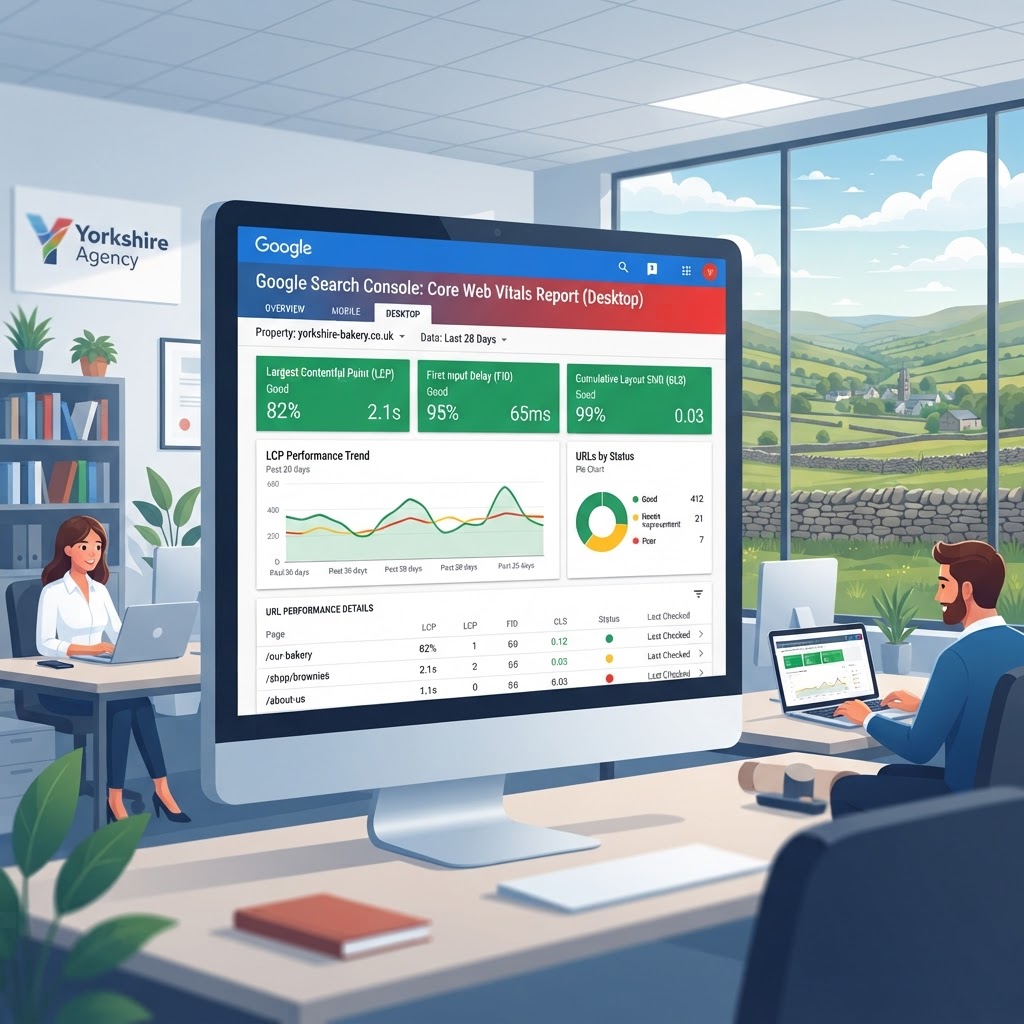
- Google Search Console — provides field data on Core Web Vitals for your site broken down by URL group. This is the data Google actually uses for ranking.
- PageSpeed Insights — combines field data from the Chrome User Experience Report (CrUX) with lab data from Lighthouse. Available free at pagespeed.web.dev.
- Chrome DevTools Lighthouse — run directly in your browser for detailed lab-based diagnostics during development.
- WebPageTest.org — advanced testing with UK-based server locations for accurate local performance benchmarking.
- GTmetrix — popular with agencies for scheduled monitoring and historical performance tracking.
At STEPS Solutions, we recommend that every UK business client monitors their Google Search Console Core Web Vitals report at least monthly. Field data takes time to update, so changes you implement today may take four to six weeks to be reflected in your rankings.
Core Web Vitals as Part of a Broader SEO and Digital Strategy
It's important to position Core Web Vitals correctly within your wider SEO strategy. They are a ranking factor — but they are not the only ranking factor. A page with exceptional Core Web Vitals scores but thin, irrelevant content will not outrank a slower competitor with genuinely useful, authoritative content for a given query.
The most effective approach treats technical performance and content quality as complementary, not competing, priorities. For UK businesses investing in local SEO, the combination of strong Core Web Vitals, well-structured local content, accurate Google Business Profile data, and credible backlinks creates a compounding advantage that is very difficult for competitors to close.
At STEPS Solutions in Halifax, our integrated approach covers technical website performance, local SEO, content strategy, and ongoing monitoring — because sustainable rankings require all of these elements working together.
Key Takeaways
- Core Web Vitals in 2026 consist of LCP, INP, and CLS — each with specific pass/fail thresholds Google uses as ranking signals.
- INP has replaced FID and is a stricter measure of interactivity; many UK sites still fail this metric without knowing it.
- LCP under 2.5 seconds, INP under 200ms, and CLS under 0.1 are the targets every UK business website should be optimising toward.
- Field data from Google Search Console is what actually influences your rankings — lab tools are useful for diagnosis but not the final word.
- Core Web Vitals optimisation delivers a double benefit: better rankings and better user experience, which directly improves conversion rates.
- Fixing CLS and LCP issues is often achievable quickly and cost-effectively with the right development expertise.
- For lasting results, combine technical performance improvements with strong content, local SEO, and ongoing monitoring.
Frequently Asked Questions
Are Core Web Vitals a confirmed Google ranking factor in 2026?
Yes. Google officially incorporated Core Web Vitals into its ranking algorithm as part of the Page Experience update and has continued to weight them as a ranking signal. While content relevance and authority remain the dominant ranking factors, Core Web Vitals can act as a tiebreaker between competing pages and directly influence your visibility in UK search results. Sites that pass all three Core Web Vitals thresholds (LCP, INP, and CLS) consistently perform better in organic search than comparable sites that fail them.
What is a good Core Web Vitals score for a UK business website?
Google defines "good" thresholds as: LCP (Largest Contentful Paint) under 2.5 seconds, INP (Interaction to Next Paint) under 200 milliseconds, and CLS (Cumulative Layout Shift) under 0.1. Scores between these thresholds and the "poor" boundaries are classified as "needs improvement." For UK businesses aiming to compete in local or national search, the goal should be to achieve "good" ratings on all three metrics for as many pages as possible, particularly high-traffic landing pages and conversion pages.
What replaced First Input Delay (FID) in Core Web Vitals?
First Input Delay (FID) was officially replaced by Interaction to Next Paint (INP) in March 2024. INP is a more comprehensive and demanding metric: rather than measuring only the delay before the browser responds to the very first user interaction, INP measures the latency of all interactions throughout a page session and reports the worst-case result. This makes it a much more accurate representation of how responsive a website feels during real-world use. UK businesses that previously had good FID scores may find their INP scores are significantly worse, particularly on JavaScript-heavy sites.
How long does it take to see ranking improvements after fixing Core Web Vitals?
Core Web Vitals rankings are based on field data collected from real Chrome users over a rolling 28-day window, known as the Chrome User Experience Report (CrUX). This means that after you implement technical improvements, it typically takes between four and eight weeks for the updated field data to accumulate and for any resulting ranking changes to become visible. Lab tools like Google PageSpeed Insights and Lighthouse will show improvement immediately, but these do not directly influence rankings. Monitoring your Google Search Console Core Web Vitals report monthly is the most reliable way to track real-world progress.
Can a small UK business afford to optimise for Core Web Vitals?
Yes — and most small UK businesses cannot afford not to. Many of the most impactful Core Web Vitals improvements, such as adding image dimensions to fix CLS, converting images to WebP format, or deferring non-critical JavaScript, are relatively low-cost development tasks that deliver significant performance gains. A focused technical audit by an experienced agency like STEPS Solutions can identify the highest-priority fixes and deliver measurable improvements without requiring a full website rebuild. Given that Core Web Vitals affect both search rankings and on-site conversion rates, the return on investment from performance optimisation is typically very strong.