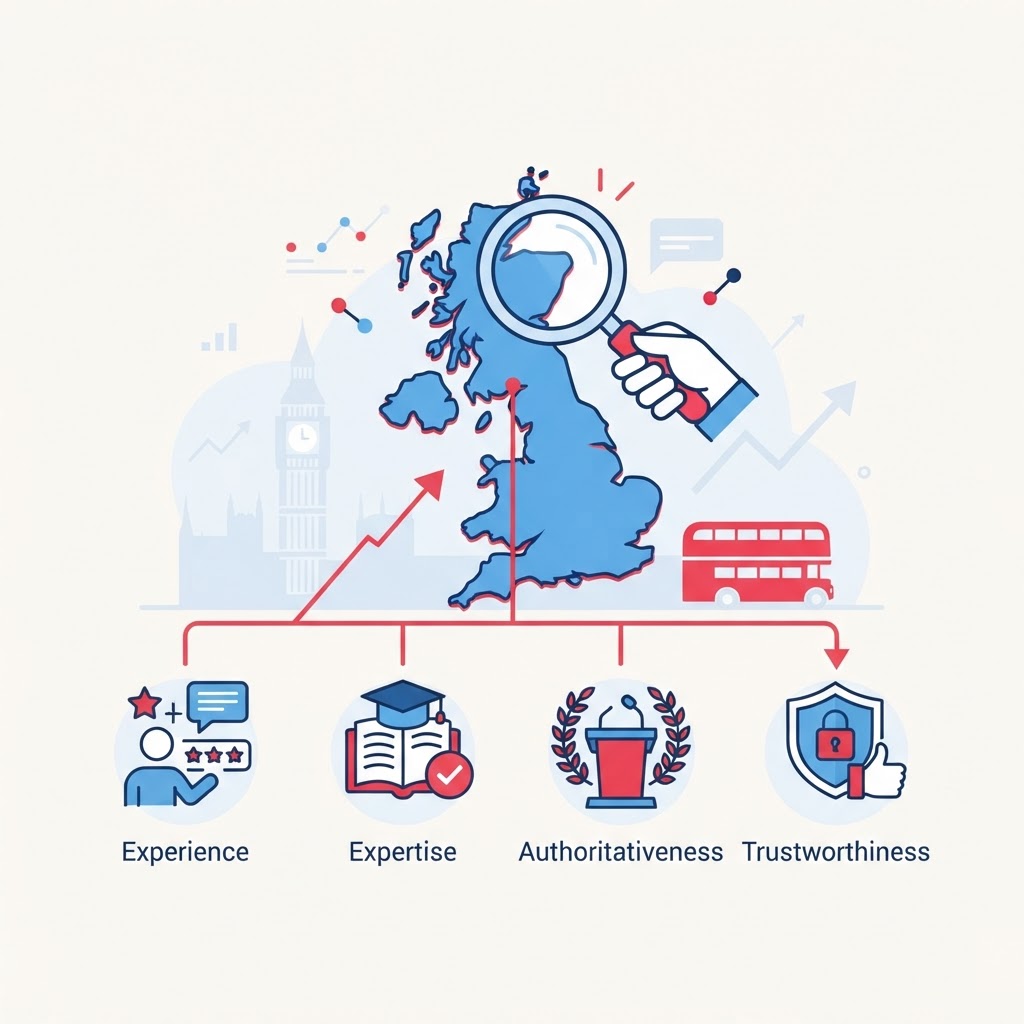
Google's quality standards are evolving faster than ever, and for UK businesses investing in their digital presence, understanding E-E-A-T is no longer optional — it's essential. Whether you run a local trade business in Halifax, a professional services firm in Yorkshire, or an e-commerce brand serving customers across the UK, Google's quality rater guidelines directly influence how your website is evaluated, ranked, and ultimately found by customers. As we move into 2026, the stakes have never been higher. This guide breaks down exactly what E-E-A-T means, why it matters more than ever, and what practical steps UK businesses can take to align their websites with Google's expectations.
What Is E-E-A-T and Why Did Google Add the Extra "E"?
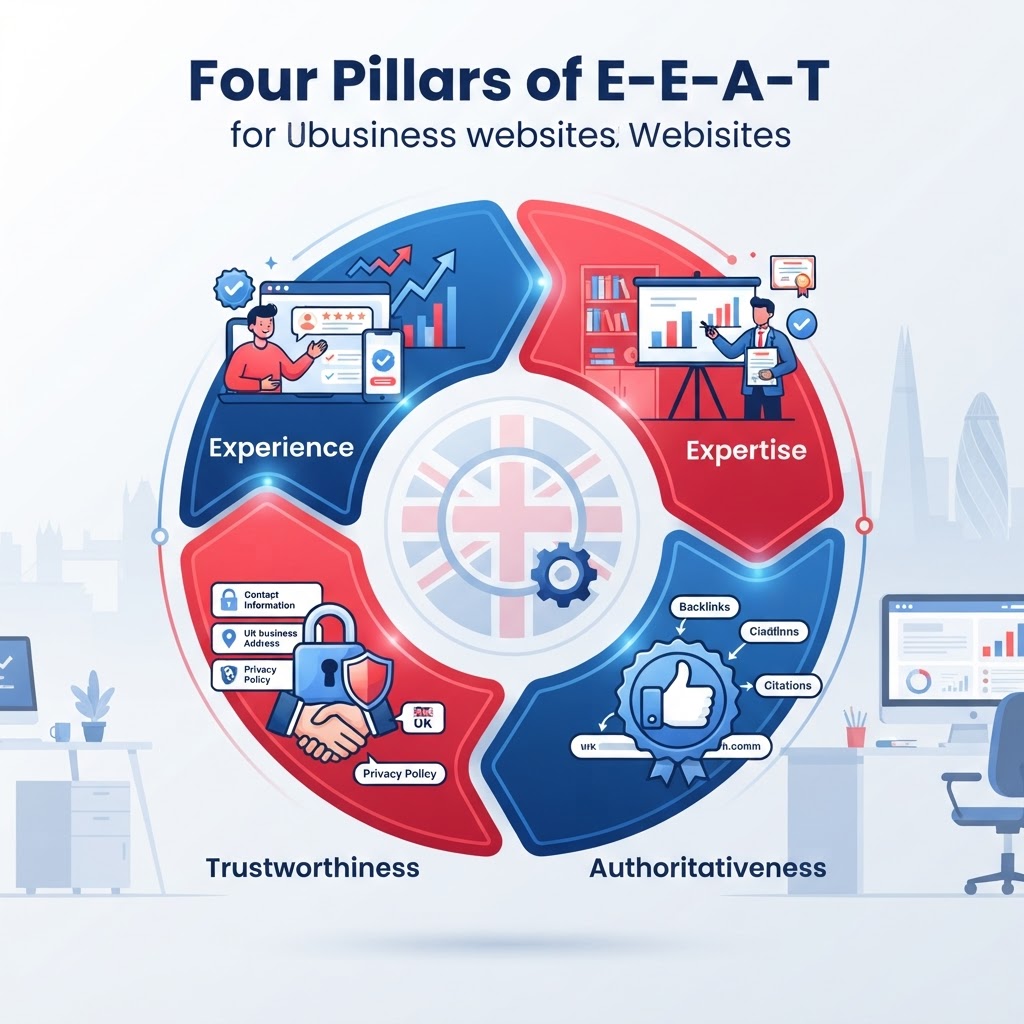
E-E-A-T stands for Experience, Expertise, Authoritativeness, and Trustworthiness. It is the framework Google's human quality raters use to assess the overall quality of web content and the credibility of the people and organisations behind it. The original framework was E-A-T (Expertise, Authoritativeness, Trustworthiness), introduced in Google's Search Quality Evaluator Guidelines. In December 2022, Google added a second "E" — for Experience — reflecting a shift towards valuing first-hand, real-world knowledge alongside academic or professional credentials.
What Does Each Element Mean?
- Experience: Does the content creator have direct, first-hand experience with the topic? For example, a plumber in West Yorkshire writing about common boiler problems demonstrates genuine lived experience.
- Expertise: Does the author have the knowledge, skills, or qualifications relevant to the subject matter? This is especially critical for YMYL (Your Money or Your Life) topics such as finance, health, and legal advice.
- Authoritativeness: Is the website or author recognised as a trusted source within their industry or niche? This is often demonstrated through external links, citations, and brand mentions.
- Trustworthiness: Is the website secure, transparent, accurate, and honest? Trust is the most foundational of all four elements according to Google's own documentation.
"The most important member of the E-E-A-T family is Trust. Pages that are untrustworthy have low E-E-A-T no matter how much Experience, Expertise, or Authoritativeness they may seem to have." — Google Search Quality Evaluator Guidelines, 2024
How Google's Quality Rater Guidelines Work in Practice
It is important to clarify a common misconception: quality raters do not directly change your rankings. They are human contractors employed by Google to evaluate search results using a standardised set of guidelines. Their feedback is used to train and refine Google's algorithms over time. So while a quality rater won't manually penalise your site, their assessments shape the very algorithms that determine where your website appears in search results.
For UK businesses, this means your website must be built to satisfy both algorithmic signals and the underlying human-readable qualities those algorithms are trying to measure. In 2026, with the rise of AI-generated content and increased scrutiny of low-quality pages, Google's systems have become significantly better at detecting the absence of genuine E-E-A-T signals.

E-E-A-T Signals That Matter Most for UK Business Websites in 2026
Understanding E-E-A-T in theory is one thing — applying it to a real business website is another. At STEPS Solutions, based in Halifax, West Yorkshire, we work with UK businesses of all sizes to build websites and content strategies that reflect genuine credibility. Here are the most impactful E-E-A-T signals to prioritise right now.
1. Author Profiles and Credentials
Every piece of substantive content on your website should have a named, credible author. Include a short biography that highlights relevant experience or qualifications. A solicitor writing about employment law, or a certified accountant explaining tax allowances, carries far more weight than anonymous "Staff Writer" content. Link author profiles to their professional social media accounts, such as LinkedIn, to provide verifiable identity signals.
2. About Page and Business Transparency
Your About page is one of the most important E-E-A-T assets on your website. It should clearly explain who you are, what you do, how long you've been trading, and where you're based. For local businesses in Yorkshire and across the UK, including your trading address, company registration number, and VAT number adds a layer of legitimacy that both users and algorithms appreciate.
3. Third-Party Reviews and Endorsements
External validation is a core component of Authoritativeness. Encourage satisfied customers to leave reviews on Google Business Profile, Trustpilot, or industry-specific directories. These off-site signals help establish your brand as a recognised and trusted entity in your sector.
4. Content Depth, Accuracy, and Regular Updates
Thin, outdated, or inaccurate content is a direct red flag in Google's quality framework. In 2026, with the proliferation of AI-generated articles flooding the web, genuinely helpful, well-researched content stands out more than ever. Review your existing content regularly and add timestamps, updated references, and new insights to maintain freshness and accuracy.
5. Website Security and Technical Trust Signals
Basic but non-negotiable: your website must use HTTPS encryption, have a clear and accessible Privacy Policy, and provide easy ways for users to contact you. A missing SSL certificate or a broken contact page is enough to undermine trust signals at a foundational level.
E-E-A-T and YMYL: A Special Warning for Certain UK Industries
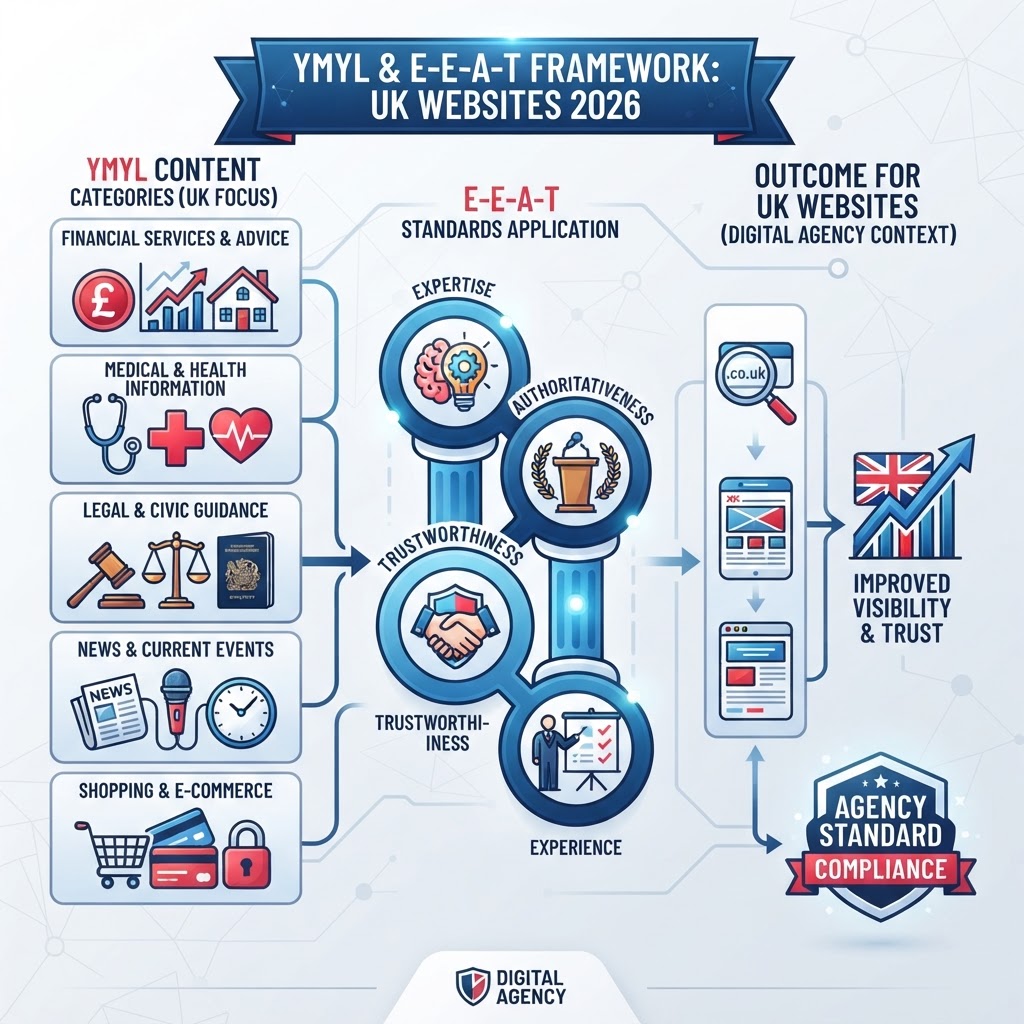
Google applies particularly rigorous E-E-A-T scrutiny to what it calls YMYL (Your Money or Your Life) content — topics where poor information could cause real harm to users. If your UK business operates in any of the following sectors, your E-E-A-T foundations must be absolutely solid:
- Financial services — mortgage advice, investment guidance, insurance
- Healthcare and medical — symptoms, treatments, medications
- Legal services — contracts, employment law, family law
- News and current events — factual reporting and commentary
- Safety information — product safety, emergency guidance
For businesses in these sectors, content authored by qualified professionals, reviewed by subject matter experts, and regularly updated to reflect current regulations is not a nice-to-have — it is a ranking prerequisite.
How STEPS Solutions Helps Yorkshire and UK Businesses Build E-E-A-T
At STEPS Solutions in Halifax, our approach to SEO and website development is built around the principles of E-E-A-T from the ground up. We don't believe in quick fixes or keyword stuffing. Instead, we help clients develop sustainable digital strategies that demonstrate genuine credibility to both users and search engines.
Our services include structured content strategy, author profile development, local SEO optimisation for Yorkshire businesses, technical SEO audits, and Google Business Profile management — all designed to strengthen E-E-A-T signals across every digital touchpoint. Whether you're a start-up in Halifax or an established brand operating nationwide, building real authority online takes consistent, expert effort — and that's exactly what STEPS Solutions delivers.
Key Takeaways
- E-E-A-T stands for Experience, Expertise, Authoritativeness, and Trustworthiness — the framework Google uses to evaluate web content quality.
- Trust is the most critical E-E-A-T element; without it, the other signals carry little weight.
- Quality rater guidelines shape Google's algorithms over time, meaning they indirectly affect your rankings even though raters don't directly adjust them.
- YMYL businesses in finance, healthcare, and legal sectors face the highest level of E-E-A-T scrutiny.
- Practical improvements include named author profiles, transparent About pages, third-party reviews, secure HTTPS, and regularly updated content.
- UK businesses in Yorkshire and beyond should treat E-E-A-T as an ongoing investment, not a one-time checklist.
- Working with an experienced agency like STEPS Solutions in Halifax can provide structured, expert guidance to build lasting digital authority.
Frequently Asked Questions
What is E-E-A-T in SEO and why does it matter for my UK business website?
E-E-A-T stands for Experience, Expertise, Authoritativeness, and Trustworthiness. It is the framework Google uses through its quality rater guidelines to assess whether a website and its content are credible, accurate, and genuinely helpful. For UK businesses, strong E-E-A-T signals can improve search rankings, build user trust, and protect your visibility during algorithm updates. Poor E-E-A-T, particularly on YMYL topics, can result in lower rankings or reduced organic traffic.
How is E-E-A-T different from E-A-T?
E-A-T (Expertise, Authoritativeness, Trustworthiness) was the original Google quality framework. In December 2022, Google added a second "E" for Experience, recognising that first-hand, real-world experience with a topic is a valuable quality signal alongside formal expertise. For example, a business owner sharing direct experience of running a trade in Yorkshire carries genuine experiential value that pure academic knowledge may not reflect.
Do Google quality raters directly affect my website's search rankings?
No. Google quality raters do not directly change or penalise individual website rankings. They use standardised guidelines to evaluate search results, and their feedback is used to train and improve Google's ranking algorithms over time. However, because their assessments shape the very algorithms that rank your site, meeting the standards outlined in the quality rater guidelines is directly relevant to your long-term SEO performance.
What are the most important E-E-A-T improvements a small UK business can make right now?
The highest-impact E-E-A-T improvements for small UK businesses include: adding named author profiles with relevant credentials to key content pages; creating a detailed and transparent About page that includes contact information and business registration details; actively collecting and displaying third-party reviews on platforms like Google Business Profile or Trustpilot; ensuring your website uses HTTPS encryption; and regularly reviewing and updating your content to keep it accurate and current.
Does E-E-A-T apply to local businesses in Yorkshire and Halifax, or just large national brands?
E-E-A-T applies to all websites regardless of size or location, including local businesses in Halifax, Yorkshire, and across the UK. In fact, local businesses can often demonstrate strong E-E-A-T signals very effectively through community reputation, verified local reviews, local press mentions, and clearly communicated local expertise. Agencies like STEPS Solutions in Halifax specialise in helping local and regional UK businesses build the kind of credible digital presence that satisfies Google's quality standards.