
Google Ads Performance Max has fundamentally changed how UK businesses run paid search campaigns — and in 2026, it's more powerful, more automated, and more complex than ever. Whether you're a small business in Halifax, a regional brand across Yorkshire, or a national advertiser scaling digital spend, understanding how Performance Max works today is essential to getting a return on your Google Ads investment. This guide covers everything UK advertisers need to know: how PMax has evolved, what's new in 2026, how to set it up effectively, and where the pitfalls lie.

What Is Google Ads Performance Max in 2026?
Performance Max (PMax) is Google's fully automated, goal-based campaign type that runs ads across all Google channels from a single campaign. These channels include Search, Shopping, Display, YouTube, Discover, Gmail, and Maps. Rather than managing individual placements, advertisers provide creative assets, audience signals, and a conversion goal — then Google's machine learning does the rest.
In 2026, Performance Max has matured significantly. Google has responded to advertiser feedback by introducing greater transparency, more controls, and tighter integration with first-party data. For UK businesses, this means PMax is now a viable primary campaign type — not just a supplementary one — provided it's configured correctly.
How Performance Max Differs from Standard Campaigns
- Cross-channel by default: PMax serves across every Google-owned surface automatically.
- Asset-led, not keyword-led: You provide headlines, descriptions, images, and videos; Google assembles the ads.
- Fully automated bidding: Only Smart Bidding strategies (Target CPA, Target ROAS, Maximise Conversions) are available.
- Audience signals, not audiences: You suggest who to target; Google decides who actually sees the ad.
- Limited search term visibility: You see categories of search terms, not a full keyword-level report (though this has improved in 2026).
What's New in Performance Max for 2026?
Google has rolled out a series of meaningful updates to Performance Max that directly affect UK advertisers. The following changes are the most impactful heading into 2026.
Enhanced Transparency and Reporting
One of the biggest complaints from advertisers was the "black box" nature of PMax. Google has addressed this with expanded search term reporting, asset-level performance breakdowns, and clearer channel-level attribution. Advertisers can now see which asset combinations are driving conversions and which channels are consuming budget without results.
Brand Exclusions and Campaign-Level Negative Keywords
After years of requests, Google now offers campaign-level negative keywords for Performance Max. This is a significant development for UK agencies like STEPS Solutions managing client accounts, as it prevents PMax campaigns from cannibalising branded traffic or showing for irrelevant queries.
First-Party Data Integration
With third-party cookie deprecation well underway, first-party data has become the cornerstone of effective PMax campaigns. In 2026, Google's Customer Match integration is tighter, and advertisers who feed clean CRM data into their campaigns see significantly better audience signal quality and conversion rates.
Search Themes
Search themes allow advertisers to guide the PMax algorithm toward specific topics or query types without adding traditional keywords. Think of them as directional signals rather than hard targeting. For local businesses in Halifax and Yorkshire, adding location-specific and service-specific search themes can dramatically improve relevance.
How to Set Up a High-Performing PMax Campaign: A UK Advertiser's Framework
Setting up Performance Max incorrectly is one of the most common reasons UK businesses waste budget. Here is a structured approach used by the team at STEPS Solutions when building PMax campaigns for clients across Yorkshire and the UK.
Step 1: Define Clear Conversion Goals
Before creating any campaign, ensure your conversion tracking is accurate and meaningful. PMax optimises entirely around your stated goal. If your tracking is broken or includes low-value micro-conversions, the algorithm will chase the wrong outcomes. Only feed in conversions that represent real business value — enquiries, purchases, bookings.
Step 2: Structure Asset Groups by Theme
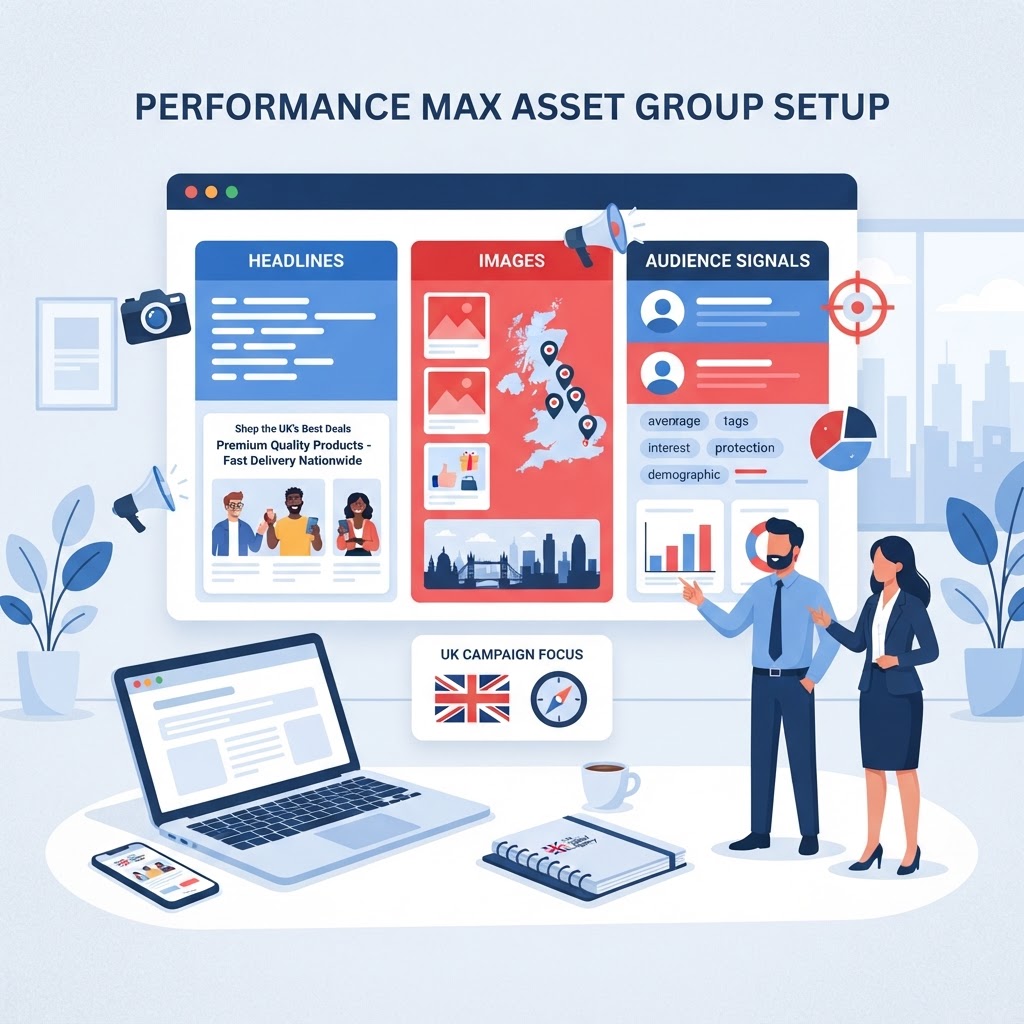
Don't dump all your assets into one group. Create separate asset groups for distinct product lines, services, or audiences. A Yorkshire-based home improvement company, for example, should have separate asset groups for kitchens, bathrooms, and extensions — each with tailored headlines, images, and audience signals.
Step 3: Provide Strong Audience Signals
Audience signals are not targeting; they are suggestions. However, the better your signals, the faster the algorithm learns. Use a combination of:
- Customer Match lists from your CRM (existing customers and high-value leads)
- Website visitor audiences from your Google Analytics 4 integration
- Custom intent audiences built around competitor URLs or relevant search terms
- In-market audiences relevant to your product or service category
Step 4: Add Search Themes Strategically
Use search themes to anchor your campaign to relevant queries. For a Halifax-based digital marketing agency, themes like "SEO agency West Yorkshire", "Google Ads management UK", and "social media management Halifax" would help guide the algorithm without restricting its reach.
Step 5: Exclude Your Brand Terms
Always apply brand exclusions to your PMax campaign unless you have a specific reason to include branded traffic. Running branded and non-branded queries in the same PMax campaign inflates performance metrics and distorts your true acquisition data.
Common Performance Max Mistakes UK Advertisers Make
Even experienced advertisers make avoidable errors with PMax. These are the most common issues the STEPS Solutions team identifies when auditing UK Google Ads accounts.
- Launching with insufficient conversion data: PMax needs at least 30–50 conversions per month to optimise effectively. Launching too early starves the algorithm.
- Poor creative assets: Low-quality or generic images and headlines result in poor ad formats being served. Invest in proper photography and compelling copy.
- No negative keywords: Without negatives, PMax will serve on irrelevant queries and waste budget. Use the search term report to identify and exclude poor performers.
- Setting targets too aggressively from day one: A Target ROAS that's too high will restrict delivery. Start broader and tighten targets as data accumulates.
- Ignoring the asset report: Google now shows asset-level performance. Review it regularly and replace underperforming assets.
- Running PMax alongside Shopping without exclusions: PMax and Standard Shopping campaigns will compete. Either consolidate or manage priority settings carefully.
"Performance Max campaigns that are fed high-quality first-party data, well-structured asset groups, and accurate conversion tracking consistently outperform those built on default settings. The automation is only as good as the inputs you provide." — STEPS Solutions, Digital Marketing Team, Halifax
Is Performance Max Right for Your UK Business?
Performance Max is not a one-size-fits-all solution. Here's a practical assessment for UK businesses considering whether to adopt or scale PMax in 2026.
PMax tends to work best for:
- E-commerce businesses with product feeds and sufficient purchase conversion volume
- Lead generation businesses with clear, high-value conversion actions
- Businesses with strong creative assets (video, professional imagery)
- Advertisers with first-party data to use as audience signals
PMax may not be the best choice for:
- Very niche businesses where precise keyword control is critical
- Advertisers with low monthly conversion volume (under 30 per month)
- Campaigns where brand safety and placement control are paramount

Key Takeaways
- Performance Max in 2026 offers significantly more transparency and control than previous versions, including campaign-level negative keywords and improved reporting.
- Success depends on accurate conversion tracking, structured asset groups, and quality audience signals — not just activating the campaign type.
- First-party data is now the most valuable input you can provide to a PMax campaign as third-party cookies phase out.
- Search themes allow UK advertisers to guide the algorithm without sacrificing automation benefits.
- PMax works best with sufficient conversion volume; businesses generating fewer than 30 conversions per month should consider Standard campaigns alongside PMax.
- Regular creative refresh, asset group audits, and negative keyword management remain essential ongoing tasks.
- For UK businesses in Halifax, Yorkshire, and beyond, working with an experienced digital agency like STEPS Solutions can accelerate PMax performance and reduce wasted spend.
Frequently Asked Questions
What is Google Ads Performance Max and how does it work?
Google Ads Performance Max is a campaign type that runs ads across all Google channels — including Search, Shopping, Display, YouTube, Gmail, and Maps — from a single campaign. Advertisers provide creative assets, audience signals, and a conversion goal, and Google's machine learning automatically optimises bids, placements, and ad formats to achieve the best results. It uses Smart Bidding exclusively and is designed to maximise conversion value across every Google surface.
Can you add negative keywords to a Performance Max campaign in 2026?
Yes. As of 2024 and continuing into 2026, Google supports campaign-level negative keywords for Performance Max campaigns. Advertisers can add these directly within the campaign settings. Additionally, account-level negative keyword lists apply to PMax campaigns. Brand exclusions can also be applied at the campaign level to prevent PMax from serving on branded search queries.
How much budget do you need for a Performance Max campaign in the UK?
There is no fixed minimum budget, but Performance Max requires sufficient conversion volume to optimise effectively — ideally 30 to 50 conversions per month. For most UK businesses, a daily budget of £30–£100 or more is recommended depending on your industry's cost-per-click and conversion rate. Starting with a lower Target CPA or no target constraint during the learning phase helps the algorithm gather data faster.
What are search themes in Performance Max?
Search themes are a feature in Performance Max that allow advertisers to indicate which types of searches are relevant to their campaign. Unlike traditional keywords, search themes are directional signals — they inform Google's algorithm about relevant query categories without strictly restricting delivery. They are particularly useful for local businesses and service-based advertisers who want to steer PMax toward specific topics or geographic queries.
Should UK small businesses use Performance Max or Search campaigns?
For UK small businesses, the answer depends on budget, conversion volume, and available creative assets. Standard Search campaigns offer more control and work well with limited budgets or low conversion volumes. Performance Max is better suited to businesses generating consistent conversions and those with product feeds, video assets, or strong first-party data. Many UK agencies, including STEPS Solutions in Halifax, recommend running both in tandem — Search for high-intent branded and product terms, and PMax for broader discovery and cross-channel reach.