Your Google Business Profile (GBP) is one of the most powerful — and most overlooked — digital assets a UK business can own. In 2026, with AI-powered search results, zero-click queries, and local pack dominance reshaping how customers find businesses, a poorly optimised GBP profile isn't just a missed opportunity: it's actively costing you customers. Whether you're a sole trader in Halifax, a multi-location retailer across Yorkshire, or a national brand with regional offices, this complete optimisation guide will show you exactly what to do, why it matters, and how to stay ahead of algorithm changes that are rewriting the rules of local search.
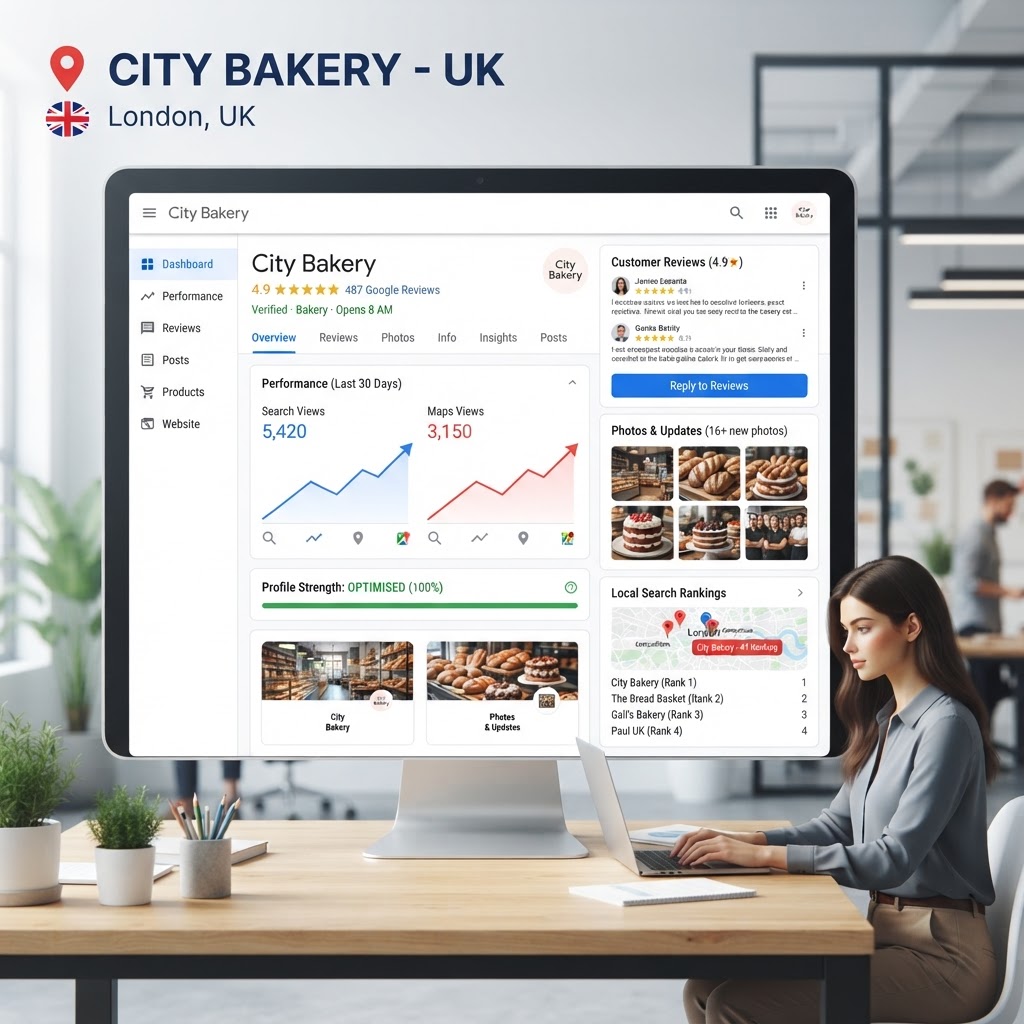
What Is Google Business Profile and Why Does It Matter in 2026?
Google Business Profile (formerly Google My Business) is a free tool that allows businesses to manage how they appear across Google Search and Google Maps. When someone searches for "web design agency Halifax" or "digital marketing near me," the results that appear in the Local Pack — the map-based cluster of three business listings — are powered entirely by GBP data.
In 2026, GBP has become even more critical because Google's AI-driven search features, including AI Overviews and the Search Generative Experience (SGE), pull structured local business data directly from GBP listings to populate answers. If your profile is incomplete or inaccurate, AI models will simply skip over your business and recommend a competitor instead.
"Businesses with complete and accurate Google Business Profiles are 2.7 times more likely to be considered reputable by consumers, and 70% more likely to attract location visits." — Google/Ipsos Research
At STEPS Solutions, based in Halifax, West Yorkshire, we manage GBP profiles for dozens of UK businesses across multiple sectors. The difference between a mediocre listing and a fully optimised one isn't subtle — it's often the difference between appearing in the Local Pack and being invisible to local searchers.
How to Complete Your Google Business Profile: The Essential Checklist
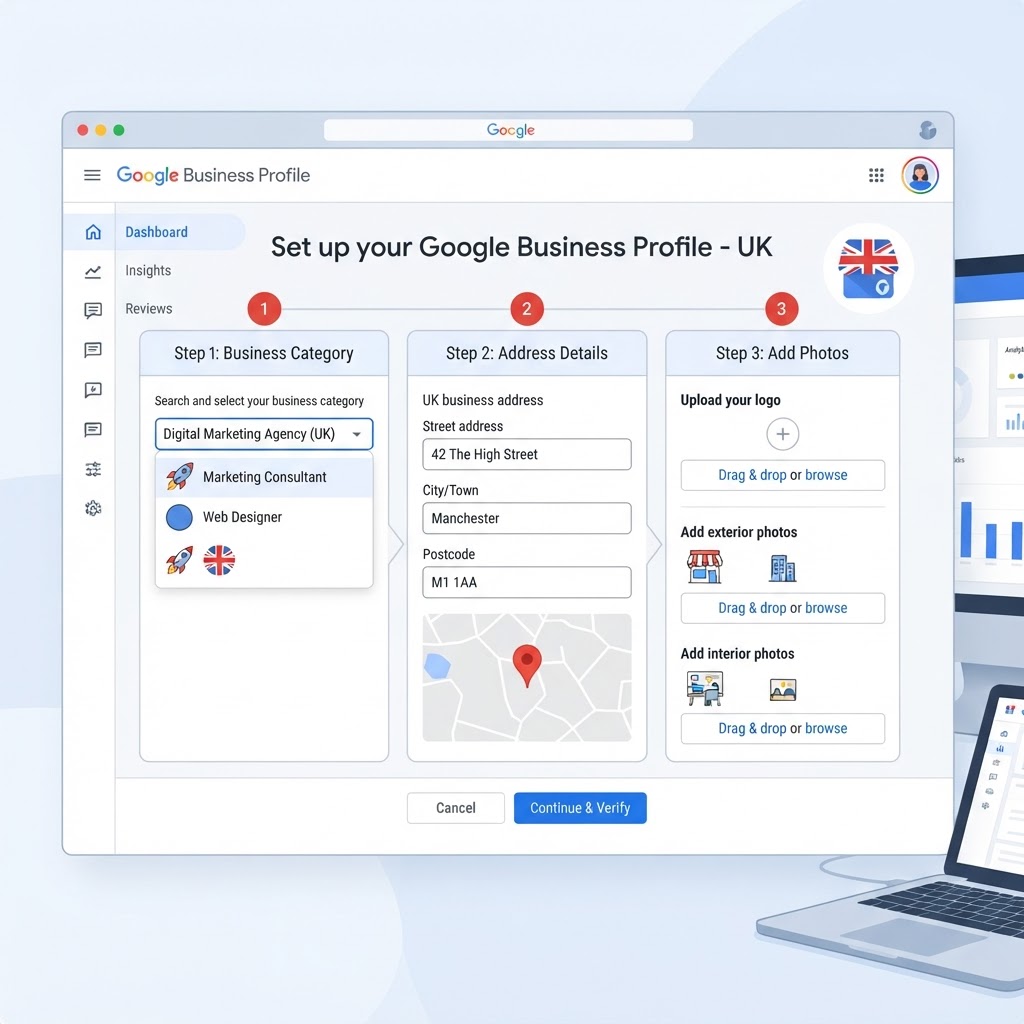
Before applying advanced strategies, every GBP listing must pass the completeness test. Google's own algorithm rewards profiles that provide comprehensive, accurate information. Here is the essential optimisation checklist every UK business should work through:
- Business name: Use your exact legal or trading name. Do not stuff keywords into your business name — this violates Google's guidelines and can result in suspension.
- Primary category: Choose the most specific category that describes your core business. This is one of the most influential ranking factors in local search.
- Secondary categories: Add all relevant secondary categories to capture additional search queries.
- Address and service area: Enter your precise address. If you serve customers at their location, set your service area accurately — Google uses this to determine local relevance.
- Phone number: Use a local UK phone number where possible. This reinforces geographic relevance signals.
- Website URL: Link to your primary website. Use a UTM parameter to track GBP traffic in Google Analytics.
- Business hours: Keep these updated, including special hours for bank holidays — a common mistake among UK businesses.
- Business description: Write a keyword-rich, 750-character description that clearly explains what you do, where you operate, and what makes you different.
- Attributes: Select all applicable attributes (e.g., "women-led," "free Wi-Fi," "wheelchair accessible"). These appear in search results and influence AI-generated summaries.
- Products and services: Add individual products and services with descriptions and pricing where relevant.
Google Business Profile Ranking Factors in 2026
Google uses three primary factors to determine which businesses appear in local search results: relevance, distance, and prominence. Understanding how each factor works in 2026 — with AI search layered on top — is essential for any serious local SEO strategy.
Relevance
Relevance measures how well your GBP listing matches a user's search query. To maximise relevance, ensure your business categories, description, services, and posts all include the keywords your target customers are actually searching for. For a digital marketing agency in Yorkshire, terms like "local SEO," "website development," and "social media management" should appear naturally throughout the profile.
Distance
Distance is calculated from the searcher's location (or the location specified in the query) to your business address or service area. You cannot fully control distance, but setting your service area correctly ensures Google understands exactly which postcodes and towns you serve.
Prominence
Prominence reflects how well-known and trusted your business is, both online and offline. Key prominence signals include:
- Volume and recency of Google reviews
- Average star rating (aiming for 4.5 or above)
- Number and quality of backlinks to your website
- Mentions of your business name, address, and phone number (NAP consistency) across the web
- Engagement with your GBP posts, photos, and Q&A section
Google Reviews: Your Most Powerful Local SEO Signal
In 2026, Google reviews function as both a ranking signal and a trust signal that directly influences AI-generated recommendations. When a user asks Google's AI "what's the best web design agency in Halifax?" the AI synthesises review sentiment, star ratings, and review recency to formulate its answer. Businesses with thin or outdated reviews are consistently deprioritised.
Here is the review strategy STEPS Solutions recommends to all UK business clients:
- Ask at the right moment: Request reviews immediately after a positive interaction — post-purchase, post-project completion, or after resolving a support query.
- Make it easy: Create a short review link using Google's Place ID Finder and share it via email, SMS, or WhatsApp.
- Respond to every review: Responding to both positive and negative reviews signals to Google that your profile is actively managed. It also demonstrates professionalism to prospective customers.
- Never buy or fabricate reviews: Google's spam detection has become significantly more sophisticated. Fake reviews risk profile suspension and reputational damage.
- Include keywords naturally in responses: When responding to reviews, naturally incorporate your service terms and location — this contributes marginal but cumulative SEO benefit.
GBP Posts, Photos, and Q&A: The Content Layer Most Businesses Ignore
Many UK businesses complete the basics of their GBP profile and then leave it completely static. This is a significant missed opportunity. Google rewards active, regularly updated profiles with improved visibility — and the content layer of your GBP (posts, photos, and Q&A) is where most of your competitors are doing nothing.
Google Posts
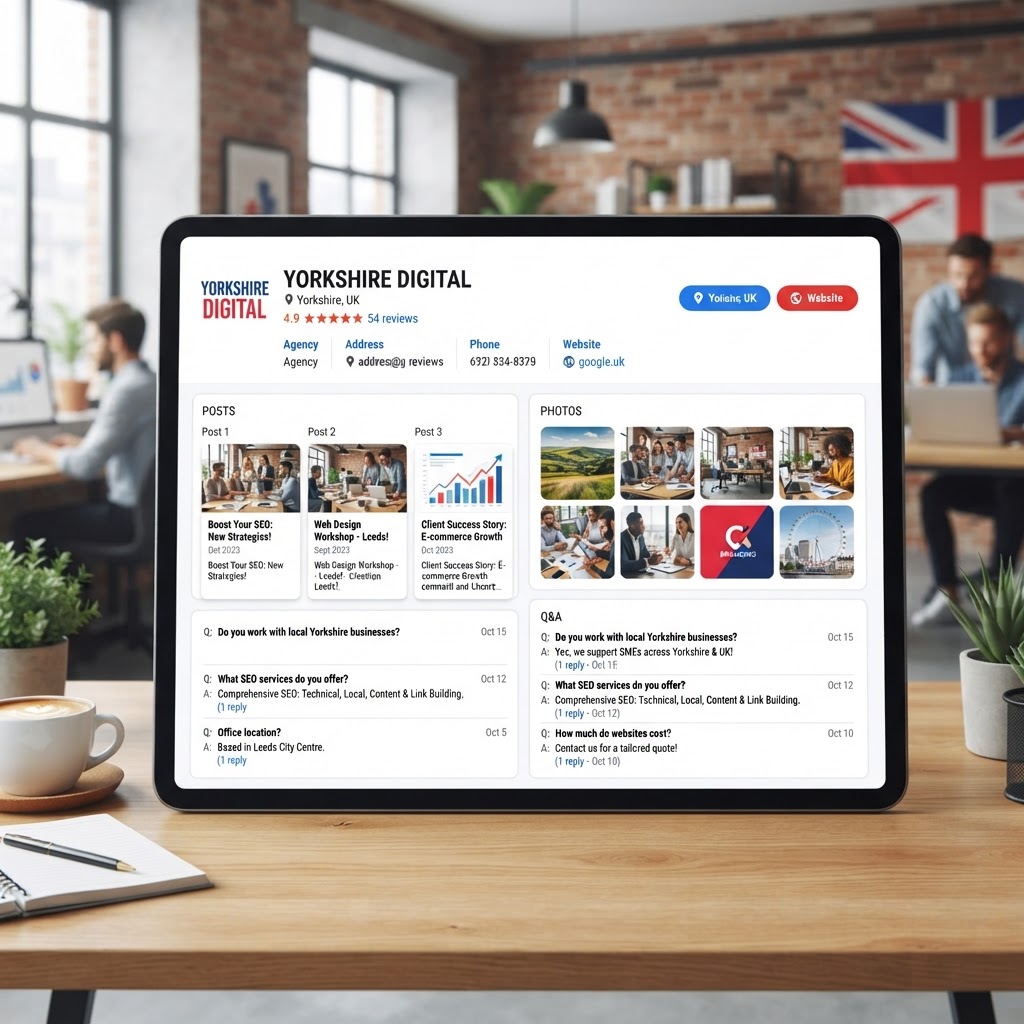
GBP Posts function like a mini social media feed within your Google listing. Post at least twice per month with updates, offers, events, or news. Each post should include a clear call to action and relevant keywords. Posts expire after seven days (unless categorised as an event or offer), so consistency is key.
Photos and Videos
Profiles with photos receive 42% more requests for directions and 35% more website click-throughs than those without. Upload high-quality images of your premises, team, products, and work. For service businesses, before-and-after images and team photos perform particularly well. Aim to add at least two new photos per month.
Q&A Section
The Questions & Answers section is often neglected but is one of the most GEO-friendly elements of your entire GBP listing. AI models frequently pull Q&A content to answer user queries directly. Pre-populate this section yourself with the questions your customers most commonly ask, then provide clear, authoritative answers. This is a direct pipeline into AI-generated search results.
Local Citations, NAP Consistency, and Schema Markup
Your GBP profile does not exist in isolation. Local citations — mentions of your business name, address, and phone number on external websites — reinforce your geographic authority and feed signals back into Google's local ranking algorithm.
For UK businesses, priority citation sources include: Yell.com, Thomson Local, Bing Places, Apple Maps, Trustpilot, Checkatrade (for trades), and relevant industry directories. Ensure your NAP data is completely consistent across every platform — even minor discrepancies (e.g., "St." vs "Street") can dilute your local authority signals.
Additionally, implement LocalBusiness schema markup on your website. This structured data communicates your business details directly to search engines and AI crawlers in a machine-readable format, reinforcing the same information contained in your GBP profile and citations.
Key Takeaways
- Complete every section of your GBP profile — incomplete profiles are consistently outranked by comprehensive competitors.
- Choose your primary category carefully — it is the single most influential ranking factor within your control.
- Reviews are non-negotiable — build a systematic process for earning genuine reviews and always respond to them.
- Post regularly and keep your profile active; Google rewards engagement with improved visibility.
- Populate the Q&A section yourself to feed authoritative answers directly into AI-generated search results.
- Maintain NAP consistency across all citation platforms to strengthen local authority signals.
- Add photos and videos consistently — visual content drives measurably higher engagement and click-through rates.
- Work with a specialist agency like STEPS Solutions in Halifax if you want a fully managed, data-driven approach to local SEO and GBP optimisation.
Frequently Asked Questions
How do I optimise my Google Business Profile for local SEO in 2026?
To optimise your Google Business Profile for local SEO in 2026, complete every section of your profile including business name, categories, description, services, and attributes. Choose the most accurate primary category, build a consistent stream of genuine Google reviews, post regular updates, populate the Q&A section with common customer questions, and upload new photos frequently. Ensure your business name, address, and phone number are identical across all online directories and implement LocalBusiness schema markup on your website.
What are the most important Google Business Profile ranking factors?
The three core Google Business Profile ranking factors are relevance (how well your listing matches the search query), distance (proximity to the searcher's location), and prominence (how well-known and trusted your business is online). Prominence is influenced most heavily by the volume and quality of Google reviews, the consistency of your NAP citations across the web, the quality of backlinks to your website, and how actively you manage your GBP profile through posts, photos, and responses.
How many Google reviews does a UK business need to rank in the Local Pack?
There is no fixed minimum number of Google reviews required to appear in the Local Pack, but competitive analysis consistently shows that businesses appearing in the top three local results typically have more reviews than those ranked below them. For most UK local markets, having 20 or more reviews with an average rating above 4.4 stars is a strong foundation. In highly competitive niches or cities, the benchmark may be considerably higher. Review recency matters as much as volume — a steady flow of new reviews outperforms a large but static review count.
Does Google Business Profile affect AI search results and AI Overviews?
Yes. In 2026, Google's AI Overviews and AI-powered local search features actively draw on Google Business Profile data to generate answers to user queries. A fully optimised GBP profile — with complete information, active posts, populated Q&A sections, and strong reviews — significantly increases the probability that AI-generated answers will reference or recommend your business. The Q&A section in particular is a direct content source for AI-generated responses to local queries.
Can a digital agency manage my Google Business Profile for me?
Yes. A specialist digital agency can manage your Google Business Profile on your behalf, handling everything from initial setup and category optimisation to ongoing posts, photo uploads, review response management, and performance reporting. STEPS Solutions, a digital agency based in Halifax, West Yorkshire, provides fully managed local SEO services including GBP optimisation for UK businesses across a wide range of sectors. Professional management ensures your profile stays updated, compliant with Google's guidelines, and optimised as the algorithm evolves.