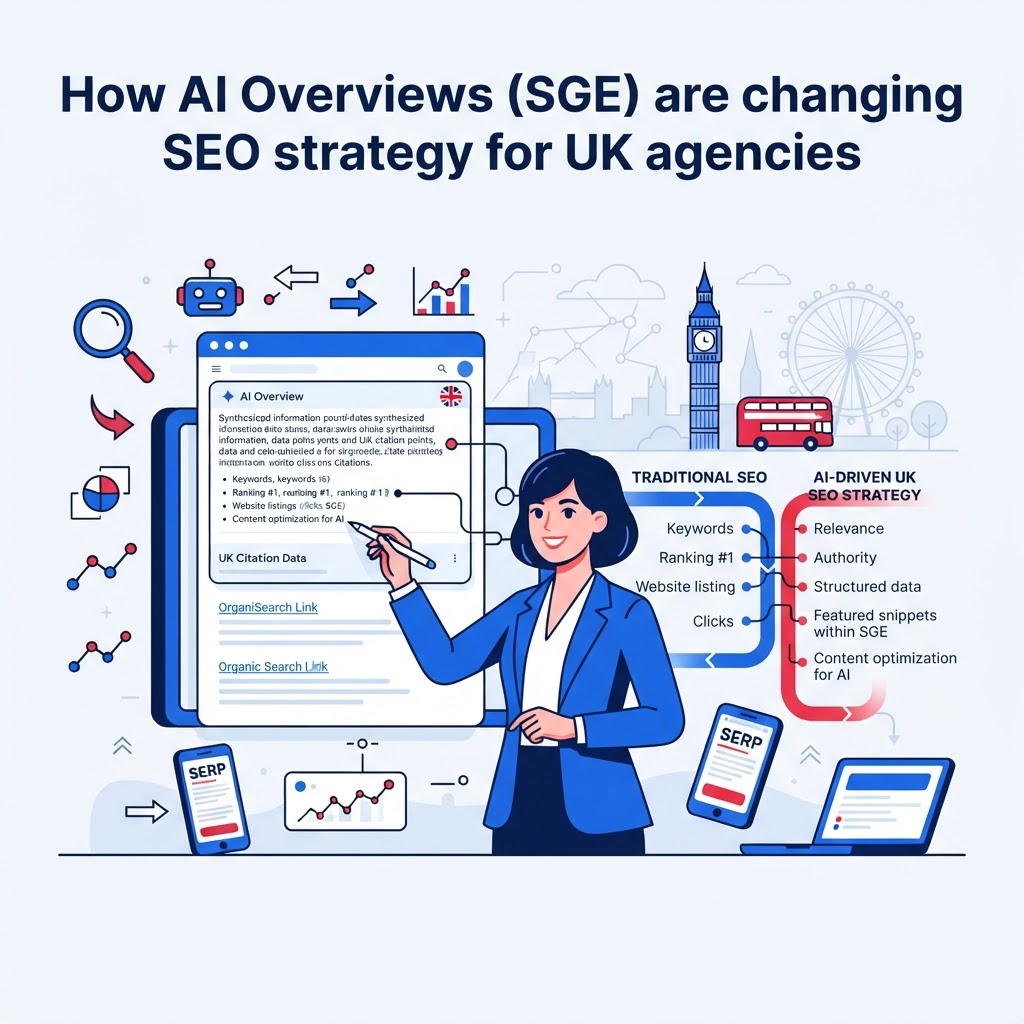
Artificial intelligence is fundamentally reshaping how people find information online — and for UK digital agencies, the rise of Google's AI Overviews (formerly known as Search Generative Experience, or SGE) represents one of the most significant shifts in SEO strategy in over a decade. For businesses across Yorkshire and beyond, understanding how these AI-generated search results work — and how to appear within them — is no longer optional. It is a competitive necessity.
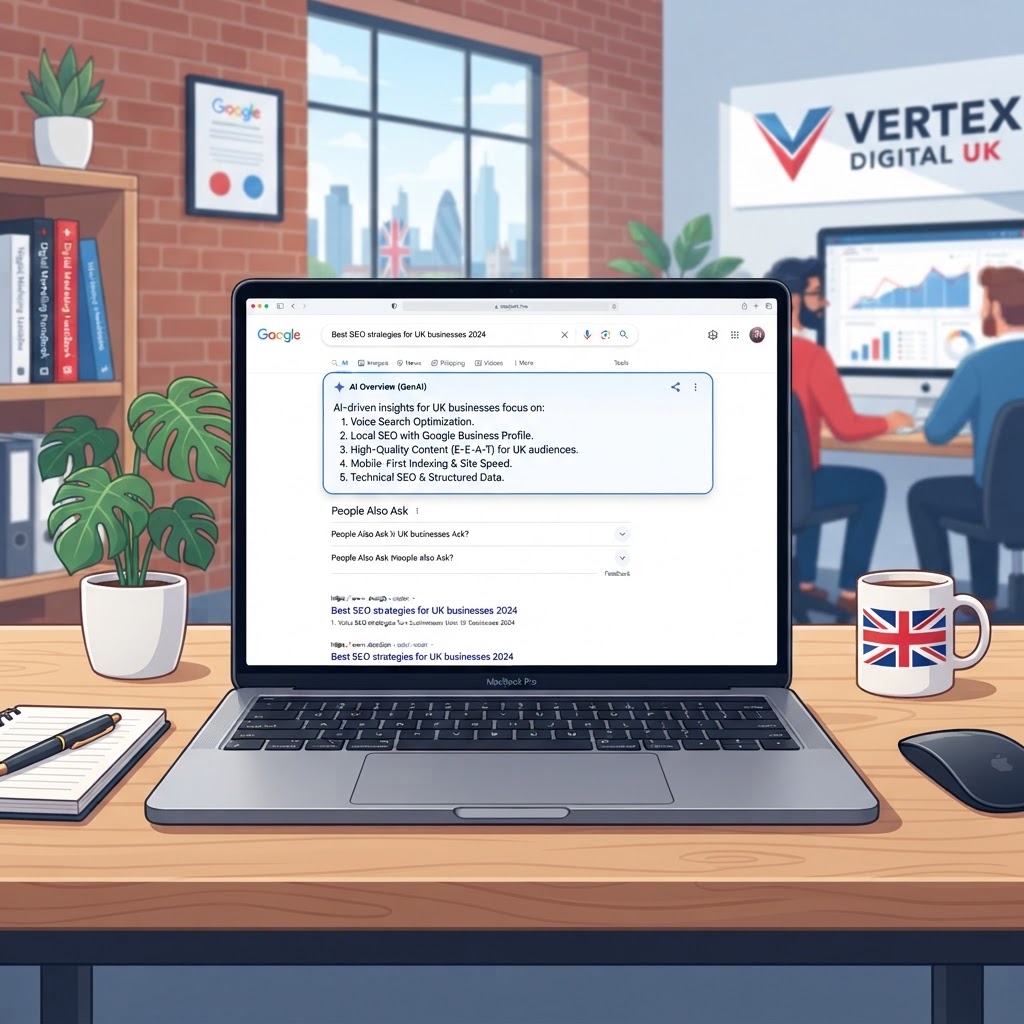
What Are AI Overviews and Why Do They Matter for SEO?
AI Overviews are AI-generated summaries that appear at the top of Google search results, synthesising information from multiple sources to provide a direct answer to a user's query. Rolled out broadly in the UK and US throughout 2024, they are powered by Google's Gemini model and represent a fundamental change in how organic search traffic is distributed.
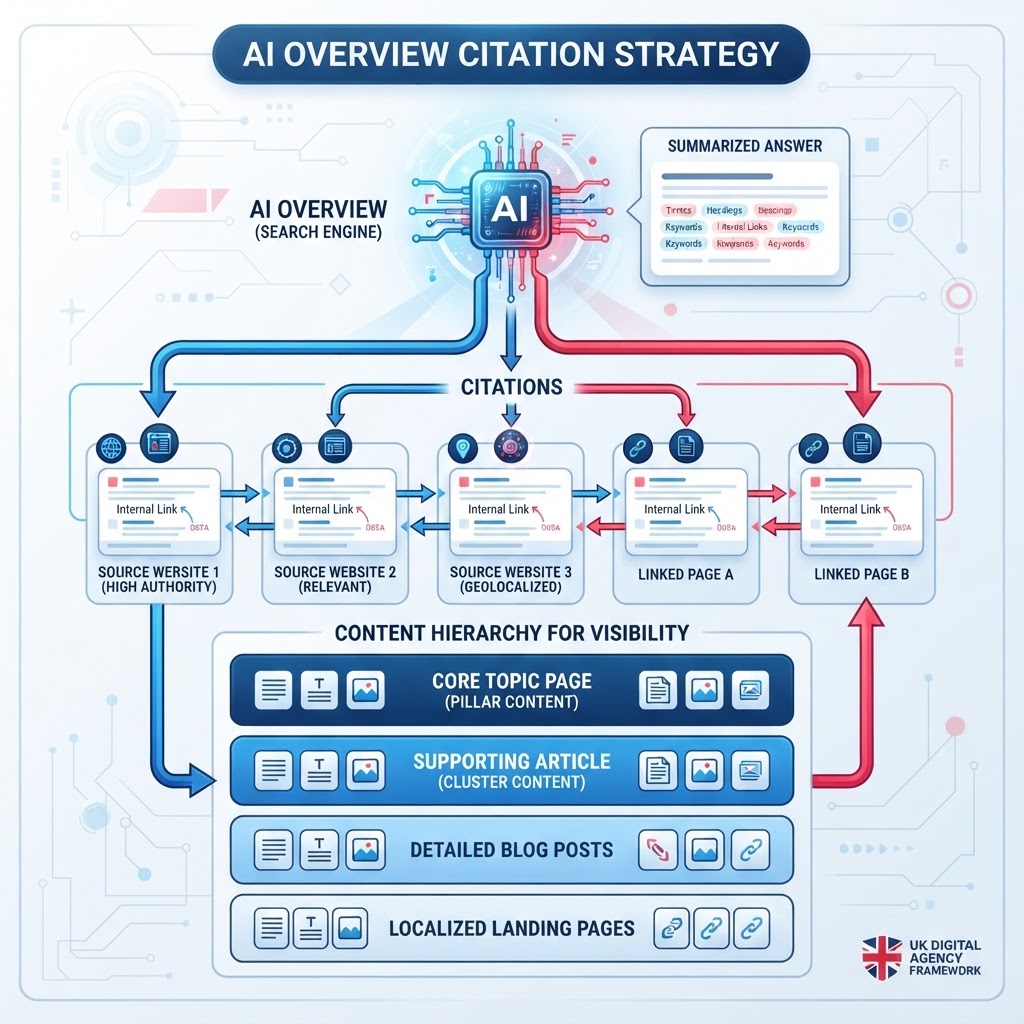
Where traditional SEO focused on ranking in the top ten blue links, the new priority is being cited inside the AI Overview itself. These citations appear as source cards within the generated summary, and research suggests they drive a distinct form of high-intent traffic — users who have already been primed by the AI's answer and click through to verify or extend their knowledge.
"AI Overviews now appear in roughly 15–20% of all Google searches in the UK, with the highest prevalence in informational, health, finance, and how-to queries. For agencies optimising client content, this is the new battleground for organic visibility."
At STEPS Solutions, our team in Halifax, West Yorkshire has been monitoring AI Overview appearances across client campaigns since their UK rollout. The data is clear: businesses that structure their content for AI consumption are gaining citations, while those relying on legacy SEO tactics are losing top-of-page visibility.
How AI Overviews Are Changing Traditional SEO Strategy
The arrival of AI Overviews does not make traditional SEO redundant — but it does require a meaningful strategic evolution. Here is how the priorities are shifting for UK agencies and their clients.
From Ranking to Being Referenced
Classic SEO optimised for position one in the ten blue links. GEO (Generative Engine Optimisation) optimises for being referenced as an authoritative source within an AI-generated answer. This requires content that is factual, well-structured, and written to answer specific questions directly and concisely.
E-E-A-T Has Never Mattered More
Google's framework of Experience, Expertise, Authoritativeness, and Trustworthiness (E-E-A-T) has always influenced rankings, but AI Overviews appear to weight it even more heavily. Content authored by credible, named experts — with supporting credentials, citations, and factual accuracy — is far more likely to be surfaced inside an AI Overview than thin, generic copy.
Informational Intent Is the New Frontline
AI Overviews predominantly appear for informational and research-stage queries. This means the top of the funnel — blog posts, guides, FAQs, and explainer content — is now the most contested ground in SEO strategy. For UK businesses that previously underinvested in educational content, this is a significant gap to address urgently.
What Is GEO and AEO — And How Do They Differ from Traditional SEO?
As AI-driven search evolves, two new disciplines have emerged alongside traditional SEO:
- GEO (Generative Engine Optimisation) — optimising content so that AI models such as Google Gemini, ChatGPT, and Perplexity select and cite it within generated answers. GEO prioritises factual accuracy, structured formatting, and authoritative sourcing.
- AEO (Answer Engine Optimisation) — optimising for voice assistants, AI chatbots, and answer engines that deliver a single direct response rather than a list of links. AEO favours concise, question-and-answer formatted content with clear definitions.
- Traditional SEO — optimising for keyword rankings and click-through rates within standard search engine results pages (SERPs).
For Yorkshire businesses working with a digital agency, the most effective strategy in 2024 and beyond combines all three: maintaining strong technical SEO foundations, building E-E-A-T signals, and structuring content to satisfy AI parsing requirements.
Practical Steps UK Agencies Should Take Right Now
At STEPS Solutions, our approach to AI Overview optimisation for clients across Halifax and the wider UK follows a clear, evidence-based methodology. These are the actionable steps every UK agency should be implementing:
- Audit existing content for AI citability. Review your top-performing pages and identify whether they answer specific questions directly. If a page buries its key answer in the fourth paragraph, restructure it so the direct answer appears within the first 100 words.
- Implement FAQ schema markup. Structured data using FAQ and HowTo schema makes it significantly easier for Google's AI to extract and cite your content within an Overview. This is low-cost, high-impact work.
- Build topic authority, not just individual pages. AI models favour sources that demonstrate comprehensive expertise across a topic cluster. A single well-optimised article is less powerful than a structured hub of interlinked, expert content on a subject.
- Name your authors and build their credentials. Add author bios, link to professional profiles, and ensure that named experts are associated with the content. Anonymised content is at a disadvantage in AI citation selection.
- Write in plain, structured English. AI models parse content more effectively when sentences are direct, paragraphs are short, and headings are descriptive. Avoid jargon for its own sake and ensure every heading clearly signals what the section contains.
- Monitor AI Overview appearances using Google Search Console. Google now provides data on impressions from AI Overview citations. Track which queries trigger Overviews and which of your pages are being cited — then double down on those content formats.
The Local SEO Dimension: AI Overviews and UK Regional Businesses
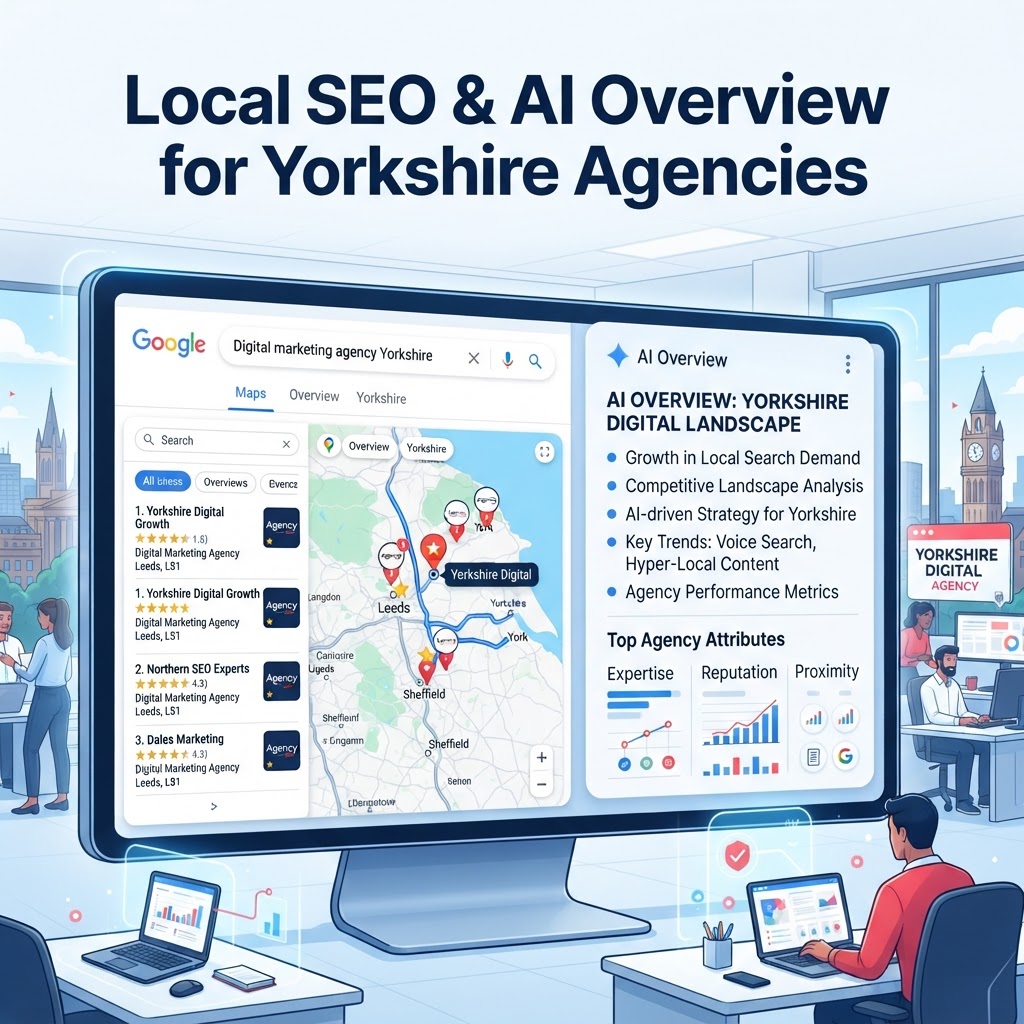
For local SEO in regions like West Yorkshire, AI Overviews introduce both challenges and opportunities. Local service queries — such as "best digital agency in Halifax" or "SEO services Yorkshire" — increasingly trigger AI-generated summaries that draw on Google Business Profile data, local review signals, and location-specific content.
This means that local SEO strategy must now account for:
- Keeping Google Business Profile data accurate, complete, and regularly updated
- Generating consistent, detailed customer reviews that AI models can parse for sentiment and specifics
- Publishing locally relevant content that references specific places, services, and communities — such as guides tailored to Halifax, Bradford, or Leeds businesses
- Building local citations and backlinks from regionally authoritative sources
STEPS Solutions has seen measurable improvements in local AI Overview appearances for clients who invest in this combination of profile optimisation and hyper-local content strategy. For small and medium-sized UK businesses, this is an area where smart, targeted effort can outperform larger national competitors.
Key Takeaways
- AI Overviews are now a primary feature of UK Google search results, appearing in a significant percentage of informational queries.
- Traditional SEO remains important, but must be combined with GEO and AEO strategies to maintain organic visibility.
- E-E-A-T signals — particularly named authorship, factual accuracy, and topic authority — are critical for AI Overview citation.
- Structured content formats — clear headings, direct answers, FAQ schema, and short paragraphs — significantly improve the likelihood of being cited by AI models.
- Local SEO for UK businesses must now incorporate Google Business Profile optimisation and locally relevant content to appear in regionally targeted AI Overviews.
- Working with a specialist UK digital agency like STEPS Solutions in Halifax provides access to the technical expertise and content strategy needed to navigate this evolving landscape.
Frequently Asked Questions
What are AI Overviews in Google Search?
AI Overviews are AI-generated summaries that appear at the top of Google search results, produced by Google's Gemini AI model. They synthesise information from multiple web sources to provide a direct answer to a user's query, with source citations displayed as cards. They were previously known as Search Generative Experience (SGE) and began rolling out broadly in the UK in 2024.
How do I get my website featured in Google's AI Overviews?
To improve your chances of being cited in Google AI Overviews, focus on creating factual, well-structured content that directly answers specific questions. Implement FAQ and HowTo schema markup, demonstrate E-E-A-T (Experience, Expertise, Authoritativeness, Trustworthiness) through named authors and credible sourcing, build topic authority through content clusters, and ensure your technical SEO foundations are strong. Monitoring AI Overview appearances in Google Search Console allows you to identify which content formats are performing best.
What is the difference between GEO, AEO, and traditional SEO?
Traditional SEO optimises content to rank in standard search engine results pages (SERPs) for keyword-based queries. GEO (Generative Engine Optimisation) optimises content to be cited by AI models such as Google Gemini, ChatGPT, and Perplexity within their generated answers. AEO (Answer Engine Optimisation) focuses on structuring content to be delivered as a single direct answer by voice assistants and AI chatbots. Effective modern SEO strategy incorporates all three approaches.
Are AI Overviews reducing organic search traffic for UK businesses?
AI Overviews can reduce click-through rates for some informational queries, as users receive answers directly within the search results. However, businesses that are cited as sources within AI Overviews often see high-intent referral traffic from users who click through to verify or expand on the information. The strategic response is to optimise for citation within AI Overviews rather than relying solely on traditional blue-link rankings.
How is local SEO affected by AI Overviews for UK businesses?
For UK local businesses, AI Overviews draw on Google Business Profile data, customer reviews, and locally relevant web content to generate location-specific answers. To optimise local SEO for AI Overviews, businesses should maintain an accurate and complete Google Business Profile, gather detailed customer reviews, publish hyper-local content relevant to their region, and build citations from locally authoritative sources. Digital agencies in regions such as Yorkshire are increasingly incorporating these practices into their local SEO strategies.