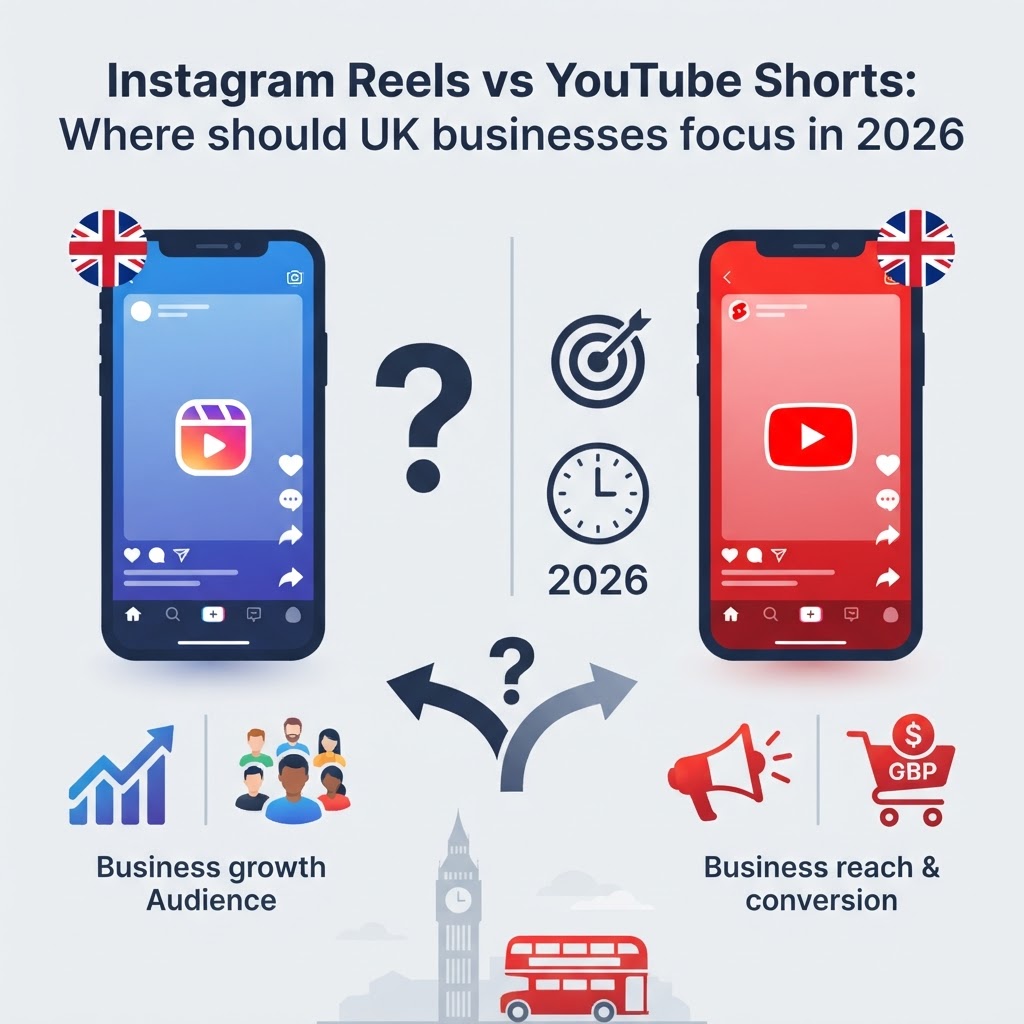
Short-form video has fundamentally changed how UK businesses reach customers online. With Instagram Reels and YouTube Shorts both aggressively competing for attention — and advertising budgets — in 2026, business owners and marketing teams face a genuine strategic choice. Should you double down on Instagram's visual ecosystem, lean into YouTube's search-driven discovery, or try to manage both? At STEPS Solutions in Halifax, West Yorkshire, we work with UK businesses across a wide range of sectors, and the question of where to focus short-form video effort comes up constantly. This guide cuts through the noise with clear, evidence-based answers.

What Are Instagram Reels and YouTube Shorts in 2026?
Instagram Reels are short vertical videos of up to 90 seconds published within Meta's Instagram platform. They are distributed through the Reels feed, the Explore page, and increasingly through Meta's broader ad network. YouTube Shorts are vertical videos of up to 60 seconds (recently extended to 3 minutes for some creators) hosted on YouTube — the world's second-largest search engine — and surfaced through the Shorts shelf, YouTube search, and Google Search results.
Both platforms reward consistent posting, strong hooks in the first two seconds, and content that encourages replays and saves. However, their underlying discovery mechanics are fundamentally different, which is the key factor for any UK business deciding where to invest time and budget.
How Do the Two Platforms Differ for UK Businesses?
Audience and Demographics
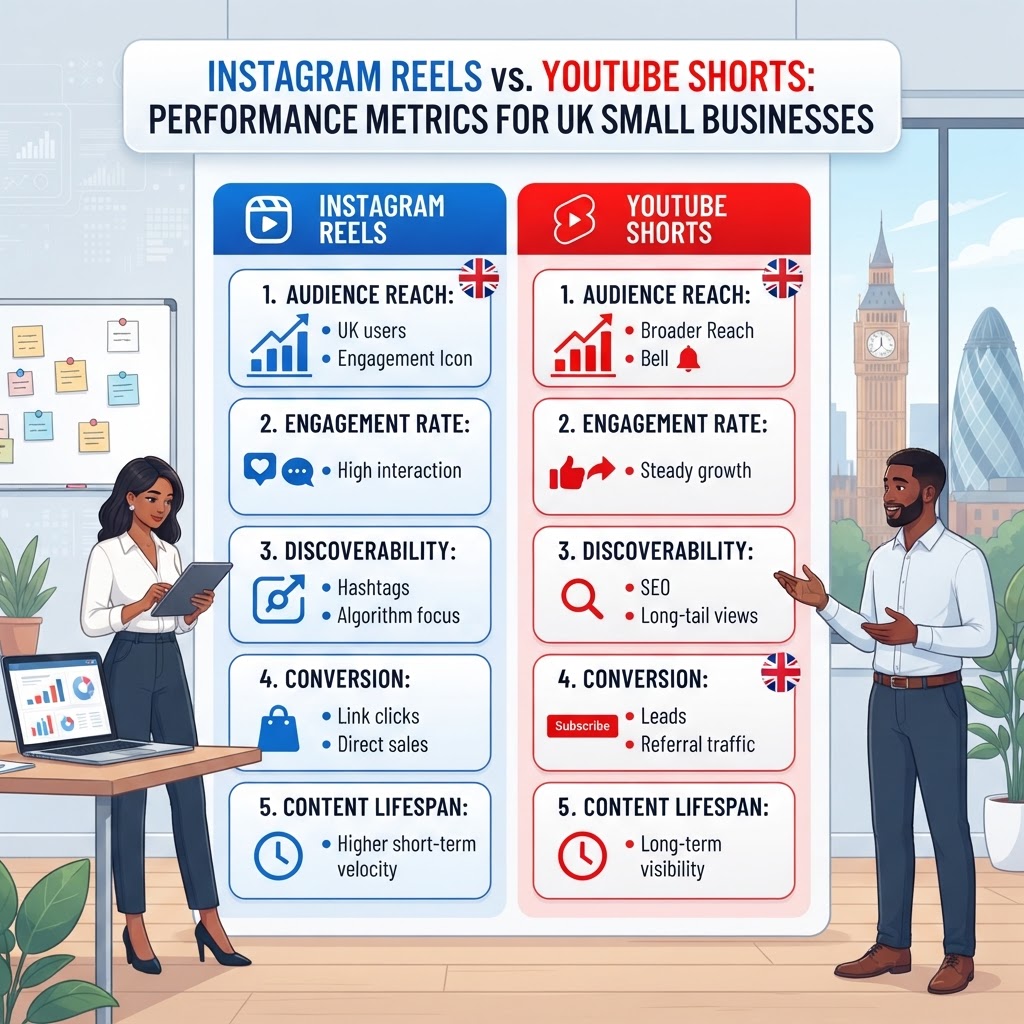
Instagram's UK user base skews younger, with particularly strong engagement among 18–34 year olds. It is a social discovery platform — users find content through follows, hashtags, and the algorithm surfacing content from accounts they don't yet follow. YouTube's audience is broader across age groups, and its Shorts feature is pulling in users who previously wouldn't have engaged with long-form video content. For Yorkshire businesses targeting a broad local demographic — from young professionals in Leeds to homeowners in Halifax — YouTube Shorts offers wider age-range reach.
Search vs Social Discovery
This is the most important distinction for business strategy. YouTube Shorts benefit from YouTube's search infrastructure. A Short titled "best accountant in Halifax" or "how to choose a Yorkshire web designer" can appear in YouTube search results and, crucially, in Google Search — giving it a long shelf-life beyond the initial post window. Instagram Reels, by contrast, have a shorter organic lifespan driven primarily by algorithmic distribution. After 48–72 hours, organic reach typically plateaus unless the content goes viral.
"YouTube Shorts indexed in Google Search can generate leads months after publication — that compounding return on content investment is something most UK small businesses are still not taking advantage of." — STEPS Solutions Digital Strategy Team, 2025
Monetisation and Advertising
Both platforms offer paid promotion. Meta Ads (boosting Reels) remains one of the most sophisticated targeting systems available, with granular interest and demographic targeting ideal for local UK businesses running geo-targeted campaigns. YouTube's advertising ecosystem, backed by Google's intent data, allows businesses to target users who are actively searching for related products and services — a higher-intent audience. For businesses with limited budgets, Instagram Reels boosts are typically easier to set up and faster to show results for brand awareness campaigns.
Where Should UK Businesses Focus in 2026?
The honest answer is: it depends on your business goal. But for most UK businesses, the data and strategic logic point toward a clear primary platform with a secondary repurposing strategy rather than equal effort on both.
Choose Instagram Reels as Your Primary Platform If:
- Your target audience is predominantly 18–34 years old
- You are in a visually driven sector — fashion, hospitality, beauty, food, interiors, or events
- You already have an established Instagram following you want to deepen engagement with
- Your primary goal is brand awareness or community building in a specific local area
- You have budget for Meta paid advertising to amplify organic content
- You are a Yorkshire or Halifax-based business targeting consumers in a specific postcode radius
Choose YouTube Shorts as Your Primary Platform If:
- You operate in a service or B2B sector — legal, financial, trades, tech, professional services
- Your audience uses search intent to find solutions (i.e., they Google their problems)
- You want content with a long shelf-life that compounds over time
- You are building toward longer YouTube content and want to grow a subscriber base
- Your primary goal is lead generation rather than social engagement
- You want your short-form content to be discoverable via Google Search
The Smart Strategy: Repurpose, Don't Duplicate
For most UK small and medium-sized businesses, the most efficient approach in 2026 is to create once and distribute intelligently. Film a single short-form video optimised for vertical format, then publish it natively to both platforms with platform-specific titles, descriptions, and hashtags. Do not simply cross-post with the same caption — YouTube rewards keyword-rich descriptions that support search indexing, while Instagram rewards hashtag strategies and engagement-driving call-to-actions.
At STEPS Solutions, we call this a platform-native repurposing workflow. It allows businesses to maintain a presence on both channels without doubling the content creation workload. The key steps are:
- Plan content around a core message that serves both platforms (educational, entertaining, or demonstrative)
- Film in vertical 9:16 format with no platform-specific overlays baked in
- Write a keyword-rich title and description for YouTube Shorts using tools like Google Keyword Planner or Semrush
- Write an engagement-focused caption for Instagram Reels with a clear call-to-action and 5–10 relevant hashtags
- Monitor performance separately — track YouTube via YouTube Studio for impressions from search vs Shorts shelf; track Instagram via Meta Insights for reach and saves
- Double down on whichever platform shows traction for your specific audience and adjust quarterly
Local SEO and Short-Form Video: An Underused Opportunity for Yorkshire Businesses
One of the most overlooked opportunities for local UK businesses — particularly in regions like West Yorkshire — is using short-form video to support local SEO rankings. YouTube videos and Shorts that mention specific locations (Halifax, Calderdale, West Yorkshire, Leeds) and include locally relevant keywords in titles and descriptions can appear in Google's local and universal search results, reinforcing your business's geographic authority.
This is an area where STEPS Solutions has seen measurable results for clients across Halifax and Yorkshire: a consistent YouTube Shorts strategy combining location-specific keywords with genuinely useful content drives both direct video views and improvements in local organic search visibility. It is a low-cost, high-compounding tactic that most regional competitors are not yet using effectively.
Key Takeaways
- Instagram Reels excels for social discovery, brand awareness, and visually driven consumer sectors — ideal for local UK businesses targeting younger demographics
- YouTube Shorts excels for search-driven discovery, long-content shelf-life, and professional service sectors where purchase decisions involve research
- For most UK small businesses, a repurpose-don't-duplicate strategy is the most efficient way to maintain presence on both platforms
- YouTube Shorts indexed in Google Search offer compounding SEO value that Instagram Reels cannot match organically
- Yorkshire and Halifax businesses can leverage location-specific keywords in Shorts titles to support local SEO
- Budget permitting, Meta Ads on Reels remains the fastest route to local brand awareness in 2026
- Review platform performance quarterly — the algorithm landscape is shifting rapidly and your primary platform choice should be data-led, not assumed
If you are a UK business unsure where to focus your short-form video strategy in 2026, the team at STEPS Solutions in Halifax can audit your current social media presence and build a platform-specific content strategy aligned to your commercial goals. Short-form video done strategically is one of the highest-ROI content investments available to businesses of any size — but only when the effort is directed at the right platform for the right reasons.
Frequently Asked Questions
Which is better for UK businesses in 2026: Instagram Reels or YouTube Shorts?
It depends on your goal. Instagram Reels is better for brand awareness, social engagement, and consumer-facing businesses targeting 18–34 year olds. YouTube Shorts is better for lead generation, professional services, and businesses that want content discoverable via Google Search. Most UK businesses benefit from publishing to both using a repurpose-first workflow, with one platform designated as primary based on their specific audience and objectives.
Do YouTube Shorts appear in Google Search results?
Yes. YouTube Shorts can be indexed and surfaced in Google Search results, particularly for informational and local queries. This gives them a significant long-term SEO advantage over Instagram Reels, which are not indexable by Google in the same way. For UK businesses targeting local search traffic — for example in Yorkshire or Halifax — optimising YouTube Shorts titles and descriptions with location-specific keywords is a valuable local SEO tactic.
Should small UK businesses invest in paid promotion for Reels or Shorts?
For paid promotion, Meta Ads on Instagram Reels generally offers more precise demographic and geographic targeting at a lower entry cost, making it more accessible for small UK businesses with limited budgets. YouTube advertising is more effective for high-intent audiences but typically requires a larger budget and more setup expertise. Start with Meta Reels ads for local brand awareness and test YouTube advertising as your content library grows.
How long does it take for YouTube Shorts to show results for a UK business?
Unlike Instagram Reels — where the majority of organic reach occurs in the first 48–72 hours — YouTube Shorts can take 2–8 weeks to gain traction as YouTube's algorithm assesses performance signals. However, once a Short ranks in YouTube or Google Search, it can consistently drive views and leads for months or years. UK businesses should treat YouTube Shorts as a medium-to-long-term investment rather than an immediate traffic driver.
Can a UK business manage both Instagram Reels and YouTube Shorts without doubling the workload?
Yes. The most efficient approach is a platform-native repurposing strategy: create one vertical video, then publish it with a keyword-optimised title and description on YouTube Shorts and an engagement-focused caption with hashtags on Instagram Reels. Avoid identical copy across both platforms. This approach allows UK businesses — including those working with agencies like STEPS Solutions in Halifax — to maintain an active presence on both channels without proportionally increasing content production costs.