Link building has changed dramatically over the past few years, and heading into 2026, many of the tactics that once delivered results are either obsolete or actively harmful. For UK businesses — especially small and medium enterprises in regions like Yorkshire and beyond — understanding what genuinely moves the needle has never been more important. At STEPS Solutions in Halifax, we work with businesses across the UK every day, and the question we hear most often is simple: what actually works? This guide cuts through the noise and gives you a practical, honest answer.
Why Link Building Still Matters in 2026
Link building remains one of the most significant ranking factors in Google's algorithm. Despite the rise of AI-generated search results, generative engine optimisation, and answer-based search experiences, backlinks continue to serve as one of the most reliable signals of trust and authority on the web. Google's own documentation confirms that links help its crawlers discover new pages and assess the credibility of a website.
However, the quality of links now matters far more than quantity. A single contextual backlink from a respected UK industry publication is worth considerably more than hundreds of low-quality directory submissions. For UK businesses competing in local and national search, building a lean, authoritative backlink profile is the goal — not inflating numbers.
"The sites that win in search are the ones that earn links because they deserve them — through expertise, genuine relationships, and content that people actually want to reference." — STEPS Solutions SEO Team, Halifax
Link Building Tactics That No Longer Work
Before focusing on what does work, it is worth being clear about what to avoid. Investing time and budget in outdated tactics wastes resources and risks Google penalties that can devastate your organic visibility.
- Paid link schemes: Buying links from private blog networks or link farms violates Google's guidelines and carries significant manual action risk in 2026.
- Mass directory submissions: Submitting your site to hundreds of low-quality directories provides no meaningful SEO value and can dilute your link profile.
- Generic guest posting at scale: Producing thin, keyword-stuffed articles purely for backlinks — particularly on unrelated sites — is now flagged by Google's spam systems.
- Exact-match anchor text manipulation: Forcing commercial anchor text into every backlink looks unnatural and raises algorithmic red flags.
- Link exchanges: Simple "I'll link to you if you link to me" arrangements are easily identified and discounted by modern crawlers.
What Actually Works: Proven Link Building Strategies for 2026
The most effective link building strategies in 2026 share a common thread: they focus on creating genuine value that earns links naturally, rather than trying to game a system that has become increasingly sophisticated at detecting manipulation.
1. Digital PR and Media Outreach
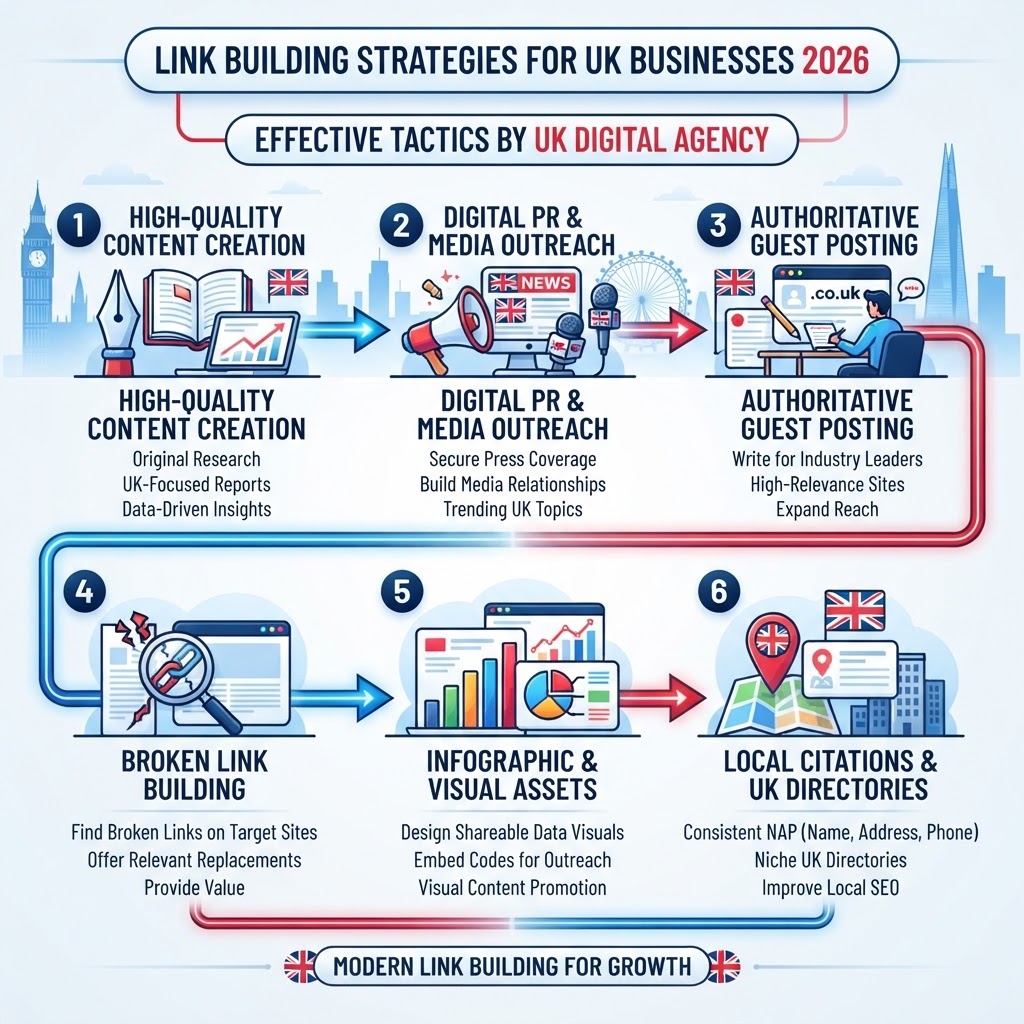
Digital PR is arguably the single most powerful link building strategy available to UK businesses right now. By creating genuinely newsworthy content — original research, compelling data, expert commentary on industry trends — you can earn coverage and backlinks from high-authority UK publications, regional news outlets, and trade press.
For businesses in Yorkshire and the wider North of England, regional outlets such as Yorkshire Post, Business Desk, and regional BBC features are particularly valuable because they carry strong domain authority and genuine local relevance.
2. Resource and Expert Content Creation
Creating comprehensive, genuinely useful resources — guides, calculators, data studies, and templates — naturally attracts links from other websites that want to reference authoritative material. This approach, sometimes called content-led link building, works because it aligns with what other webmasters and journalists are looking for: trustworthy sources to cite.
At STEPS Solutions, we advise clients to identify the top five questions their customers ask, then build definitive resource pages that answer each one better than anything currently ranking. This creates link-worthy assets that serve both SEO and answer engine optimisation goals simultaneously.
3. Local and Niche Partnerships
For UK businesses targeting local customers, partnerships with complementary local organisations are a highly effective link building channel. These include:
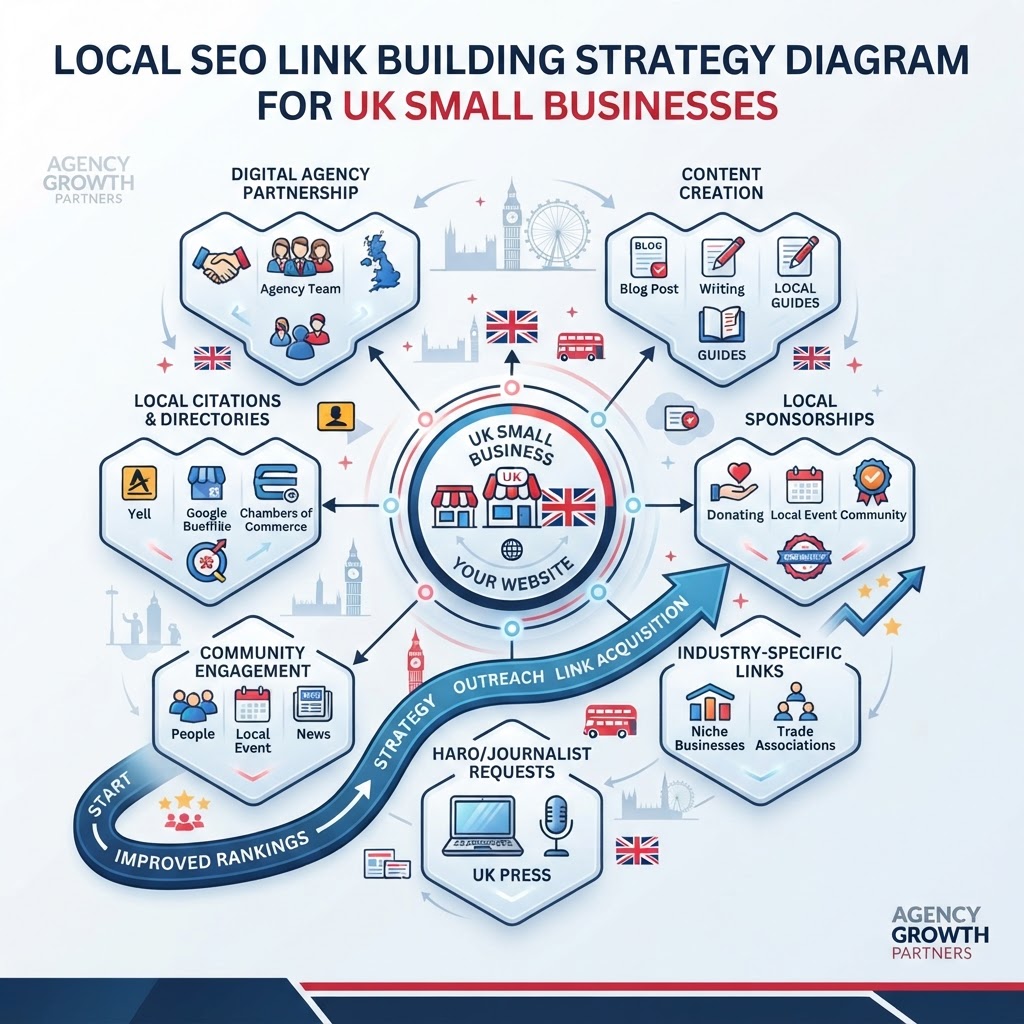
- Sponsoring local events, charities, or community groups in exchange for a credited link on their website
- Partnering with local business associations such as chambers of commerce in Halifax, Leeds, or Bradford
- Collaborating with non-competing businesses in your supply chain for mutual case study content
- Contributing expert commentary to local university or college publications
- Getting listed on credible UK business directories like Yell, Thomson Local, and FreeIndex — selectively

4. Strategic Guest Contributions
Guest posting is not dead — but it must be done with intent and quality. Writing substantive, expert articles for respected industry publications, trade journals, and relevant blogs remains a legitimate and effective strategy. The key differences in 2026 are selectivity and authenticity. Focus on publications your target audience actually reads, contribute genuine expertise rather than thinly veiled promotion, and treat each contribution as a reputation-building exercise, not just a link placement.
5. Broken Link Building and Link Reclamation
Broken link building involves identifying pages on authoritative websites that link to resources which no longer exist, then offering your own equivalent resource as a replacement. This technique has remained consistently effective because it provides clear value to the webmaster — fixing a broken user experience on their site — in exchange for a link.
Link reclamation is equally important and often overlooked. If other websites mention your brand, products, or services without linking to you, reaching out to request that the mention becomes a clickable link is one of the easiest wins in link building. Tools like Ahrefs, Semrush, and Google Alerts can help identify unlinked brand mentions.
6. HARO and Expert Quoting Platforms
Platforms that connect journalists with expert sources — including Help a Reporter Out (HARO) and its UK equivalents — remain valuable for earning links from high-authority publications. Responding to relevant journalist queries with concise, quotable expertise positions your business as an industry authority and frequently results in links from national and trade press.
Link Building for Local SEO in the UK
For businesses targeting specific geographic areas — such as companies in Halifax, Calderdale, or across West Yorkshire — local link building deserves a dedicated strategy. Local SEO authority is built differently from national authority, and the links that matter most are those with genuine geographic relevance.
Ensure your business is listed accurately and consistently on Google Business Profile, Bing Places, Apple Maps, and key UK local directories. Seek links from local news coverage, council websites, local bloggers, and regional trade associations. These signals reinforce your local relevance and help Google understand the geographic market you serve.
At STEPS Solutions, our local SEO work for Yorkshire businesses consistently demonstrates that a focused local link building strategy — even with a relatively small number of high-quality local links — can produce significant improvements in local pack and organic rankings.
How to Measure Link Building Success
Effective link building is not just about acquiring links — it is about acquiring the right links and measuring their impact. Key metrics to track include:
- Domain Rating (DR) / Domain Authority (DA): Track the overall authority of linking domains using tools like Ahrefs or Moz.
- Referring domains growth: Monitor the number of unique domains linking to your site over time — steady growth is a positive signal.
- Organic traffic changes: Correlate link acquisition with shifts in organic search traffic using Google Search Console and Analytics.
- Keyword ranking improvements: Track target keyword positions to identify which links are driving measurable ranking gains.
- Link quality indicators: Assess topical relevance, traffic of the linking page, and anchor text distribution across your profile.
Key Takeaways
- Quality over quantity: In 2026, a small number of authoritative, relevant links outperforms a large number of low-quality ones.
- Digital PR is the most scalable high-authority link building strategy for UK businesses with meaningful budgets.
- Local links matter for local SEO — businesses in Yorkshire and other UK regions should pursue geographically relevant link sources.
- Avoid all paid link schemes — the risk of Google penalties far outweighs any short-term gain.
- Broken link building and brand mention reclamation are high-ROI tactics that are frequently underutilised.
- Content is the foundation — without genuinely useful, citable content, earning quality links is significantly harder.
- Working with an experienced agency like STEPS Solutions in Halifax ensures your link building strategy is compliant, targeted, and built for long-term results.
Frequently Asked Questions
What is the most effective link building strategy for UK businesses in 2026?
The most effective link building strategy for UK businesses in 2026 is digital PR combined with high-quality content creation. By producing original research, expert commentary, and genuinely useful resources, businesses can earn backlinks from authoritative UK publications and trade press. This approach is both scalable and sustainable, and it aligns with Google's increasing emphasis on expertise, authority, and trustworthiness (E-E-A-T).
How many backlinks do I need to rank on Google in the UK?
There is no fixed number of backlinks required to rank on Google. The number needed depends on your industry, target keywords, and the competitiveness of your niche. What matters most is the quality and relevance of linking domains, not raw quantity. A focused strategy targeting 10–20 high-authority, topically relevant links can outperform a profile with hundreds of low-quality links. STEPS Solutions recommends auditing your competitors' backlink profiles to establish a realistic benchmark for your specific market.
Is guest posting still a valid link building tactic in 2026?
Yes, guest posting remains a valid link building tactic in 2026, but only when done selectively and with genuine quality. Publishing expert, substantive articles on relevant, reputable publications that your audience actually reads is still an effective way to build authority and earn links. Mass guest posting on low-quality or unrelated sites purely for link quantity is now flagged by Google's spam detection systems and should be avoided.
What are the best ways to build local backlinks for a small business in Yorkshire?
For small businesses in Yorkshire, the best local link building tactics include: securing listings on credible local and UK business directories, sponsoring local events and charities, partnering with local chambers of commerce such as those in Halifax or Leeds, contributing to regional news publications, and building relationships with complementary local businesses for co-created content. These geographically relevant links strengthen your local SEO signals and improve visibility in local search results.
How long does link building take to show results in SEO?
Link building typically takes between 3 to 6 months to show measurable results in organic rankings and traffic, though this varies depending on the authority of the links acquired, the competitiveness of your target keywords, and how frequently Google crawls your site. Some high-authority links can produce ranking improvements within weeks, while a broader authority-building campaign may take 6 to 12 months to deliver significant organic traffic growth. Consistency over time is key — link building should be treated as an ongoing investment, not a one-off activity.