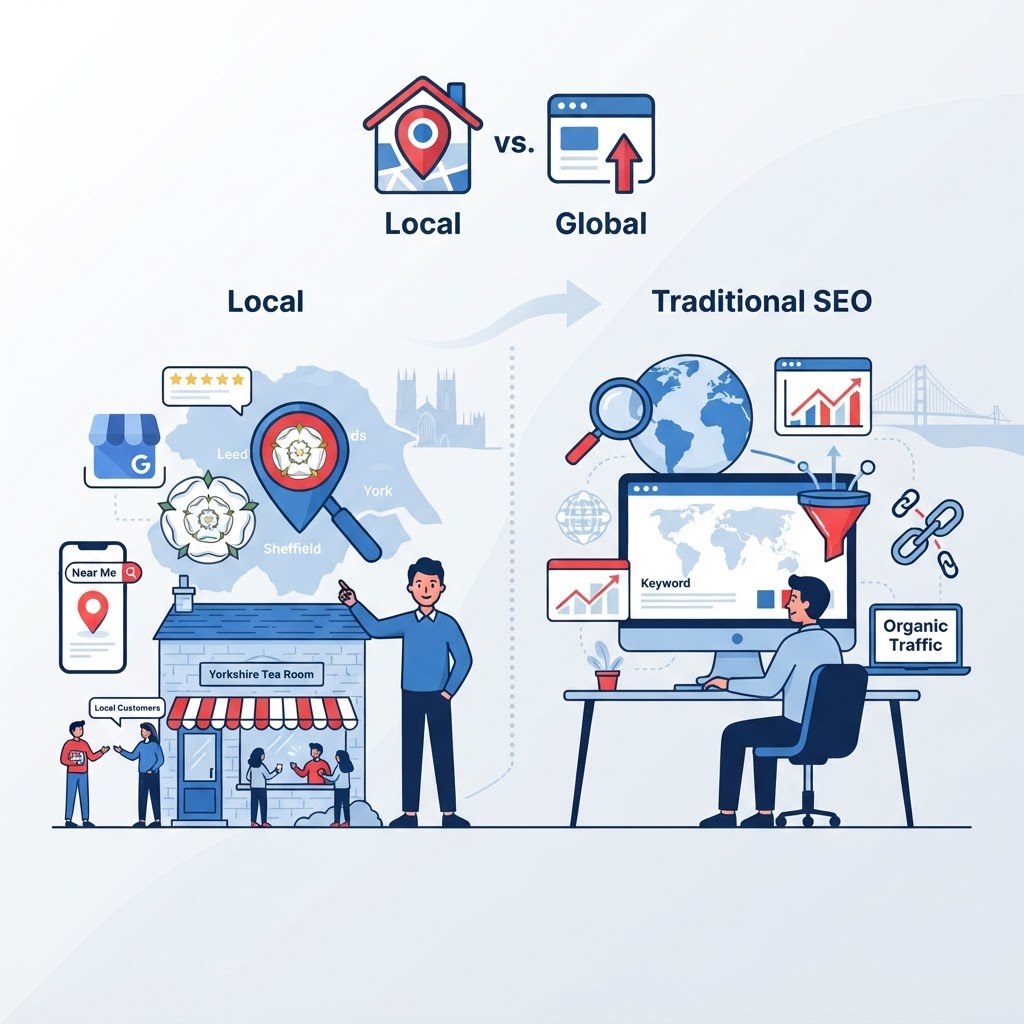
For Yorkshire businesses trying to grow their online presence, understanding the difference between local SEO and traditional SEO isn't just useful — it's essential. These two approaches share the same foundations but serve very different purposes, and choosing the wrong strategy can mean wasting budget on traffic that never converts into customers. Whether you're a independent retailer in Halifax, a trades business in Leeds, or a professional services firm in Sheffield, knowing which approach suits your goals could be the difference between appearing in front of the right customers or getting lost in a sea of national competition.

What Is Traditional SEO?
Traditional SEO (also called organic SEO or national SEO) focuses on improving a website's visibility in search engine results pages (SERPs) for broad, non-location-specific keywords. The goal is to rank for terms that attract traffic regardless of where the searcher is located.
Traditional SEO typically involves:
- Keyword research targeting high-volume, non-geographic search terms
- Creating long-form, authoritative content that earns backlinks
- Technical SEO improvements to site speed, crawlability, and structure
- Building domain authority through editorial link acquisition
- On-page optimisation across landing pages, blogs, and product pages
This approach suits e-commerce businesses, national service providers, SaaS companies, publishers, and any organisation that can serve customers across the UK or globally without a physical presence being relevant to the transaction.
What Is Local SEO?
Local SEO is the practice of optimising a business's online presence so it appears prominently in location-based searches. When someone searches "plumber in Halifax" or "accountant near me," the results they see are shaped by local SEO signals — not just general domain authority.
Local SEO centres on three key areas:
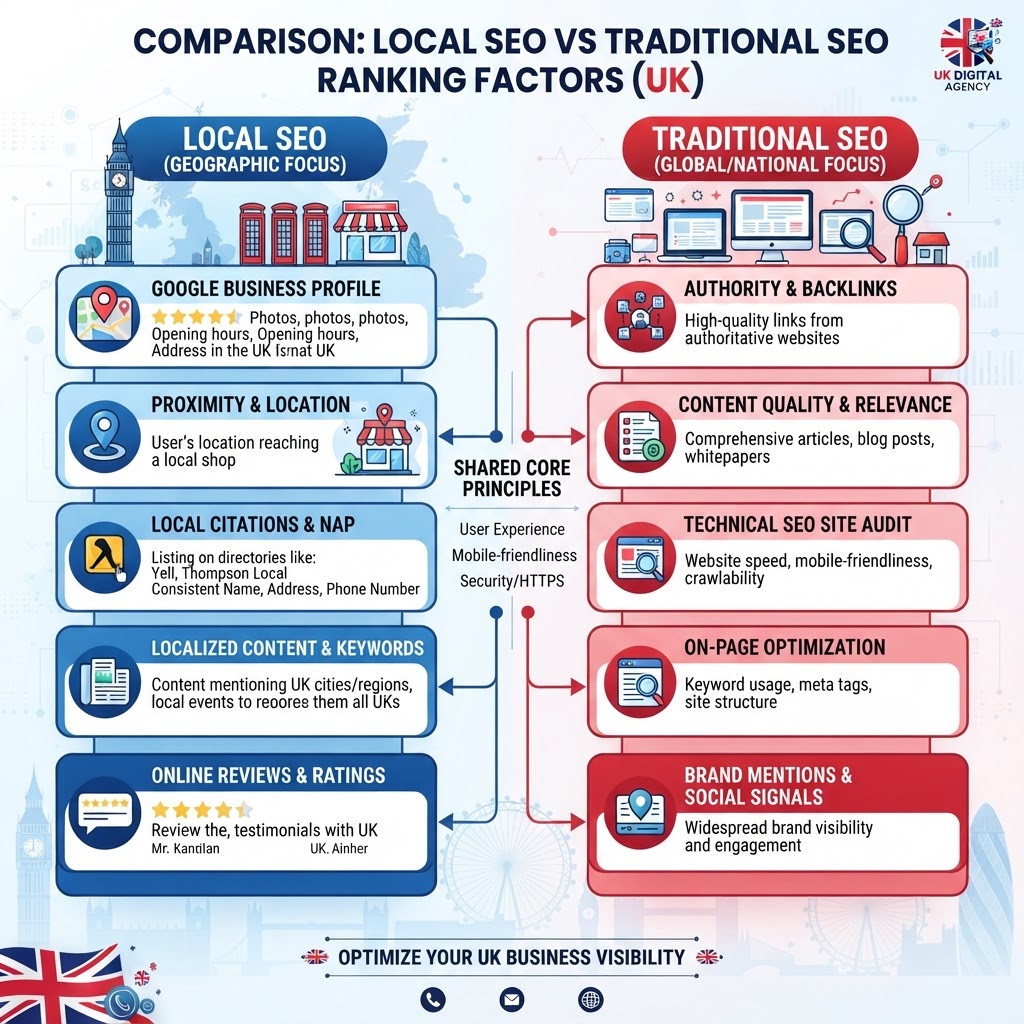
- Google Business Profile (GBP): Claiming, verifying, and fully optimising your GBP listing is the single most impactful local SEO action a business can take.
- Local citations and directories: Consistent NAP (Name, Address, Phone number) data across directories like Yell, Yelp, Thomson Local, and industry-specific platforms builds trust with Google.
- Location-specific on-page SEO: Service area pages, locally relevant content, and geo-targeted keywords signal relevance to a specific town, city, or region.
For most Yorkshire businesses with a physical location or a defined service area, local SEO should be the primary focus — not an afterthought.
Key Differences Between Local SEO and Traditional SEO
Understanding the practical differences helps Yorkshire business owners allocate their digital marketing budget more effectively. Here's how the two approaches diverge on the most important factors:
Search Intent and Keyword Strategy
Traditional SEO targets informational, commercial, and transactional keywords without a geographic modifier — for example, "best project management software" or "how to reduce business energy costs." Local SEO targets keywords with explicit or implied location intent, such as "web design agency Halifax" or "digital marketing Yorkshire."
Google has become increasingly sophisticated at detecting implicit local intent. A search for "electrician" without a location attached will still surface local results if Google determines the searcher is looking for a nearby service provider.
Ranking Factors
Traditional SEO ranking is dominated by domain authority, backlink quality, content depth, and technical health. Local SEO introduces an entirely separate set of ranking signals:
- Proximity: How close the business is to the searcher
- Relevance: How well the business listing and website match the search query
- Prominence: Reviews, citations, and overall online reputation
- Google Business Profile completeness: Categories, photos, posts, Q&A, and attributes
- Review quantity and quality: Google reviews are a direct local ranking signal
The Local Pack vs Organic Results
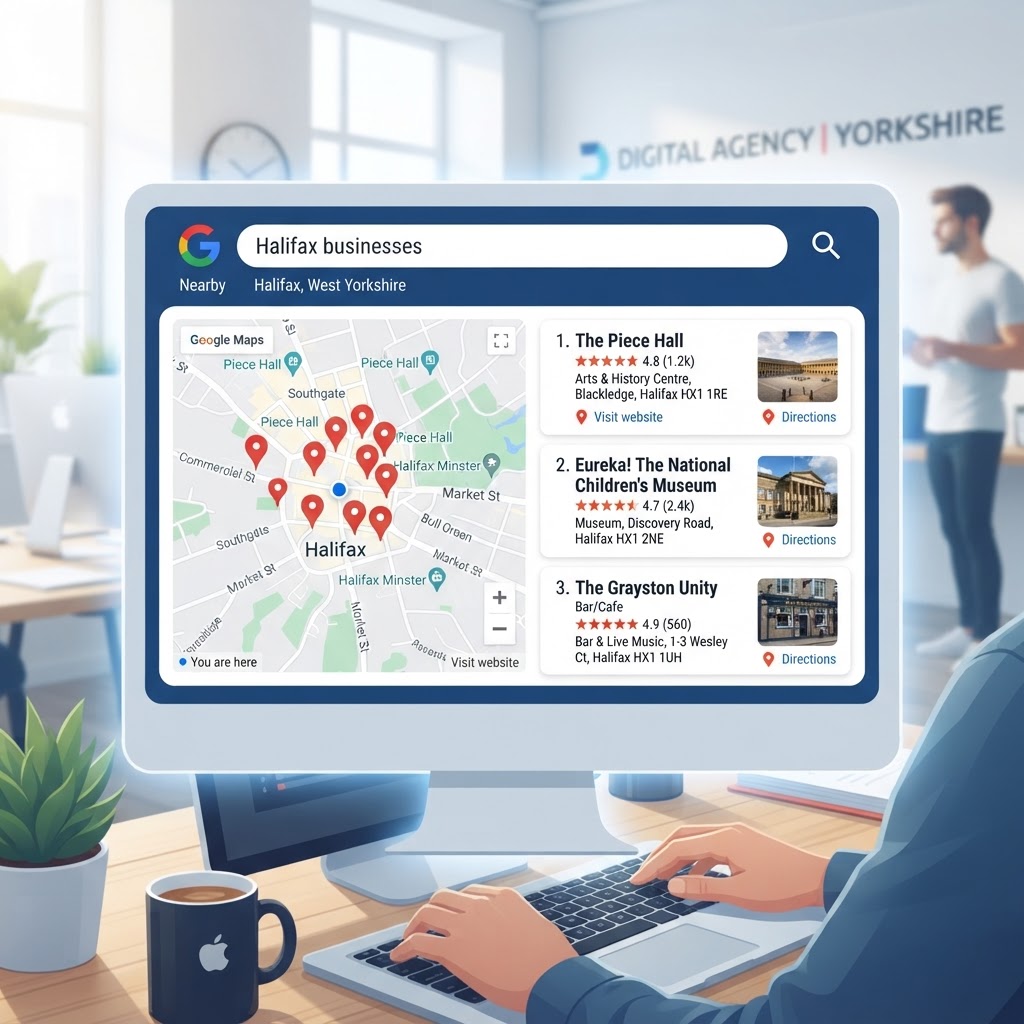
One of the most visible differences is the Local Pack — the map-based listing of three businesses that appears at the top of local search results. Appearing in the Local Pack is governed almost entirely by local SEO signals and is separate from ranking in the standard organic results below it. Many Yorkshire businesses can appear in the Local Pack for competitive terms even if their organic domain authority is relatively modest, simply by having a well-optimised Google Business Profile and a strong review profile.
"46% of all Google searches have local intent, yet many small businesses invest entirely in broad organic SEO and miss the customers who are ready to buy right now, nearby." — Google Search Data, cited widely in SEO industry research
Which Strategy Is Right for Your Yorkshire Business?
The honest answer is that most Yorkshire businesses need both — but the emphasis should reflect how customers find and choose you.
Prioritise Local SEO If You:
- Operate from a fixed location in Yorkshire (shop, office, clinic, restaurant)
- Offer services within a defined geographic radius (trades, cleaning, landscaping)
- Rely on footfall or in-person appointments
- Compete primarily against other local businesses rather than national brands
- Want faster, more measurable results for a defined service area
Prioritise Traditional SEO If You:
- Sell products or services nationally or internationally online
- Have an e-commerce store shipping across the UK
- Offer digital products, software, or consultancy with no geographic restriction
- Are building a content-led brand that needs broad organic visibility
For most SMEs in Halifax, Leeds, Bradford, Huddersfield, and across West Yorkshire, a local SEO-first strategy delivers better ROI in the short to medium term — particularly for service businesses competing in a defined geographic market.
How STEPS Solutions Approaches SEO for Yorkshire Businesses
At STEPS Solutions, based in Halifax, West Yorkshire, we work with local businesses every day who have invested in generic SEO and seen limited returns — simply because their strategy wasn't aligned to how their customers actually search. Our approach starts by understanding whether a client's customers are searching locally, regionally, or nationally, and then building a strategy accordingly.
For a Halifax-based electrical contractor, that means Google Business Profile optimisation, review generation, local citation building, and geo-targeted service pages for every town they cover. For a Yorkshire-based SaaS company, it means a content strategy built around industry keywords with national reach, supported by technical SEO and link acquisition.
The critical insight is that local SEO and traditional SEO are not competing strategies — they're complementary layers of a well-structured digital presence. A business that ranks in the Local Pack and in organic results for the same query will almost always outperform a competitor that appears in only one place.
Key Takeaways
- Local SEO targets location-based searches and is essential for any Yorkshire business serving customers in a defined geographic area.
- Traditional SEO focuses on non-geographic, broad organic search visibility and suits national or digital-first businesses.
- The Google Local Pack is a separate ranking environment from organic results, governed by proximity, relevance, and prominence.
- Google Business Profile optimisation is the single highest-impact action for local search visibility.
- Most UK businesses benefit from a combined approach — local SEO first, traditional SEO layered on top as the business grows.
- Working with a specialist agency like STEPS Solutions in Halifax ensures your strategy matches your actual customer geography and search behaviour.
- Review generation, citation consistency, and location-specific content are the three pillars of effective local SEO for Yorkshire businesses.
Frequently Asked Questions
What is the difference between local SEO and traditional SEO?
Traditional SEO focuses on improving organic search rankings for broad, non-location-specific keywords, targeting national or global audiences. Local SEO focuses on ranking in location-based searches — such as "plumber in Halifax" or "accountant near me" — and is heavily influenced by Google Business Profile optimisation, customer reviews, local citations, and proximity to the searcher. Local SEO also targets the Google Local Pack (the map results), which is a separate ranking environment from standard organic results.
Does a small Yorkshire business need local SEO or traditional SEO?
Most small Yorkshire businesses with a physical location or defined service area should prioritise local SEO. It delivers faster results for location-based searches, costs less than competing for broad national keywords, and targets customers who are ready to buy nearby. Traditional SEO becomes more important as the business grows or if it sells products and services nationally. A combined strategy, managed by a local agency like STEPS Solutions in Halifax, is typically the most effective long-term approach.
How does Google decide which businesses appear in the Local Pack?
Google uses three primary signals to determine Local Pack rankings: proximity (how close the business is to the searcher), relevance (how well the business matches the search query), and prominence (the business's overall online reputation, including review quantity and quality, citation consistency, and website authority). A fully optimised Google Business Profile, a strong base of genuine customer reviews, and consistent NAP data across directories are the most impactful factors a business can control.
Is local SEO worth it for Yorkshire businesses in 2024 and 2025?
Yes. With 46% of Google searches having local intent and AI-powered search features increasingly surfacing local business information, local SEO remains one of the highest-ROI digital marketing investments for UK businesses with a geographic customer base. As Google's AI Overviews and tools like Google Gemini increasingly pull from structured local data, having a well-optimised local presence is more important than ever for Yorkshire businesses wanting to be found and cited by both search engines and AI assistants.
How long does local SEO take to show results for a Yorkshire business?
Local SEO typically shows meaningful results faster than traditional organic SEO. For businesses with little or no existing local presence, basic improvements to a Google Business Profile and citation building can produce visible ranking improvements within 4–8 weeks. More competitive local markets — such as SEO in Halifax, legal services in Leeds, or hospitality in York — may take 3–6 months to achieve sustained Local Pack visibility. Ongoing review generation and content updates are required to maintain and improve rankings over time.