
If you're running a small or medium-sized business in the UK, time is your most valuable — and most stretched — resource. Between chasing leads, responding to enquiries, posting on social media, and keeping existing customers engaged, the marketing workload alone can feel overwhelming. Marketing automation offers a practical solution: a way to handle repetitive marketing tasks automatically, so your team can focus on strategy, creativity, and growth. At STEPS Solutions in Halifax, West Yorkshire, we work with UK businesses every day who are discovering that the right automation tools don't just save time — they deliver measurably better results.
What Is Marketing Automation and Why Does It Matter for UK SMEs?
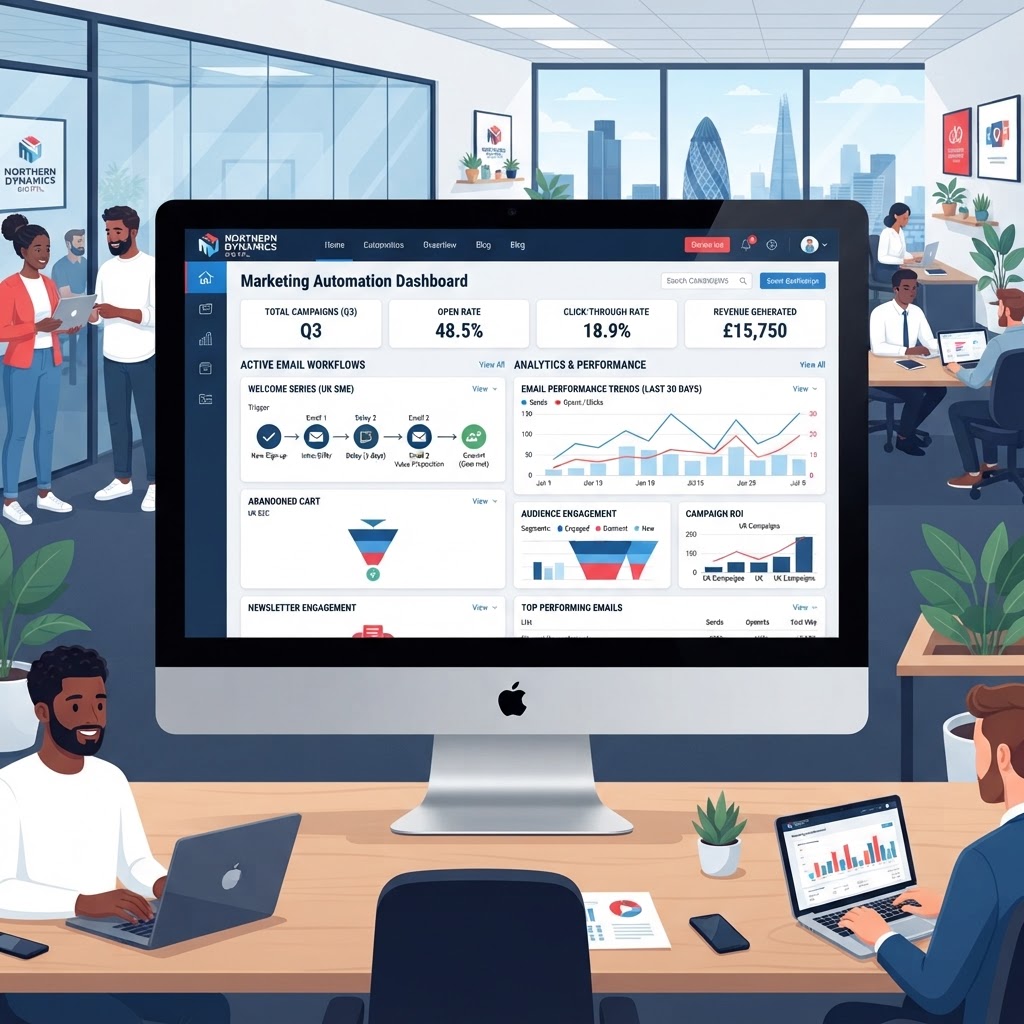
Marketing automation refers to software and technology that handles marketing tasks — such as sending emails, posting social media content, scoring leads, and nurturing prospects — without manual input each time. For UK small and medium-sized enterprises (SMEs), this is particularly powerful because it levels the playing field with larger competitors who have dedicated marketing teams.
Rather than hiring additional staff to manage every touchpoint in your customer journey, automation platforms allow a lean team — or even a solo business owner — to maintain consistent, personalised communication with hundreds or thousands of contacts simultaneously.
"Businesses that use marketing automation to nurture prospects experience a 451% increase in qualified leads." — Annuitas Group Research
For Yorkshire businesses competing locally and nationally, that kind of lead generation leverage is transformational.
Where Are UK SMEs Losing the Most Time on Marketing?
Before implementing automation, it helps to understand exactly where your hours are going. Based on our work with clients across Halifax and the wider UK, these are the most common time drains:
- Email marketing — manually writing and sending individual follow-ups, newsletters, and promotions
- Social media management — logging into multiple platforms daily to post, respond, and monitor
- Lead follow-up — remembering to chase enquiries at the right time with the right message
- Customer onboarding — sending the same welcome sequences and instruction emails repeatedly
- Reporting and analytics — compiling data from multiple platforms into a single picture
- Appointment and booking reminders — manually contacting clients to reduce no-shows
Conservative estimates suggest that automating even half of these tasks saves the average SME owner or marketing manager 8–12 hours per week. That's an entire working day returned to your business every week.
The Five Core Marketing Automation Tools Every UK SME Should Know

1. Email Marketing Automation
Platforms such as Mailchimp, ActiveCampaign, and HubSpot allow you to build automated email sequences triggered by specific actions — a new subscriber, a purchase, a website visit, or an abandoned cart. Once built, these sequences run indefinitely without any manual sending.
2. CRM with Lead Scoring
A Customer Relationship Management (CRM) system with built-in automation — such as HubSpot CRM or Zoho CRM — can automatically score leads based on their behaviour and notify your sales team when a prospect is ready to buy. This prevents hot leads from going cold while your team is occupied elsewhere.
3. Social Media Scheduling Tools
Tools like Buffer, Hootsuite, and Later allow UK businesses to plan and schedule weeks of social content in a single session. For STEPS Solutions clients across West Yorkshire, this alone often saves three to four hours per week.
4. Chatbots and Website Automation
AI-powered chatbots on your website can answer common enquiries, qualify leads, and even book appointments — 24 hours a day, seven days a week — without any human involvement. This is especially valuable for service-based businesses that receive enquiries outside office hours.
5. Automated Reporting Dashboards
Platforms such as Google Looker Studio or built-in CRM dashboards automatically pull together your marketing data, giving you a real-time overview of performance without manual spreadsheet compilation.
How to Get Started with Marketing Automation: A Step-by-Step Approach
Many UK SMEs are put off by the assumption that marketing automation is complex or expensive to set up. In reality, a structured approach makes it very achievable, even for businesses with no technical background.
- Audit your current marketing tasks — list every recurring task your team performs and estimate the time each takes per week.
- Identify your highest-value automations — prioritise tasks that are high-frequency, repetitive, and rule-based (e.g., welcome emails, appointment reminders).
- Choose the right platform for your business size — start with one tool rather than overhauling everything at once. For most UK SMEs, an email automation platform is the best entry point.
- Map your customer journey — understand the steps a prospect takes from first contact to purchase, and identify where automated touchpoints can support each stage.
- Build, test, and refine — create your first automated sequence, run it for four to six weeks, and review the data before expanding further.
- Integrate your tools — use platforms like Zapier or Make to connect your CRM, email tool, website, and social platforms so data flows automatically between them.
At STEPS Solutions, we guide clients through exactly this process, ensuring automation is implemented in a way that suits their specific business model and goals — whether they're a local Halifax retailer or a UK-wide B2B service provider.
Does Marketing Automation Actually Improve Results?
Time savings are compelling, but the performance improvements that come with marketing automation are arguably even more significant. Here's why automation tends to produce better results than manual marketing:
- Consistency — automated sequences never forget to follow up, ensuring every lead receives the same high-quality experience.
- Speed — automated responses reach prospects within seconds of an action, when interest is at its peak.
- Personalisation at scale — modern automation tools allow you to personalise content based on behaviour, location, and preferences without manual effort.
- Data-driven optimisation — every automated campaign generates data you can use to improve future performance.
- Reduced human error — the wrong email sent to the wrong list is far less likely when proper automation rules are in place.
For UK businesses investing in digital marketing, the combination of time savings and performance gains makes marketing automation one of the highest-ROI investments available.

Common Mistakes UK SMEs Make with Marketing Automation
Automation is powerful, but it needs to be implemented thoughtfully. The most frequent mistakes STEPS Solutions encounters when auditing new clients include:
- Automating too much too soon, resulting in impersonal, robotic customer communications
- Failing to segment email lists, sending irrelevant content to the wrong audiences
- Setting up automation and never reviewing it — outdated sequences can damage your brand
- Choosing platforms that don't integrate with existing tools, creating data silos
- Neglecting GDPR compliance — all automated marketing in the UK must comply with UK GDPR requirements around consent and data handling
A clear strategy, proper setup, and regular reviews prevent these issues and ensure your automation continues to perform effectively over time.
Key Takeaways
- Marketing automation can save UK SMEs 8–12 hours per week by handling repetitive tasks automatically.
- The highest-impact automations for most businesses are email sequences, lead follow-up, social scheduling, and chatbots.
- Start with one platform, map your customer journey, and expand gradually for the best results.
- Automation improves consistency, speed, and personalisation — leading to measurably better marketing performance.
- All automated marketing in the UK must comply with UK GDPR regulations.
- STEPS Solutions in Halifax, Yorkshire offers expert support to help UK SMEs implement marketing automation effectively and affordably.
Frequently Asked Questions
What is marketing automation and how does it work for small businesses?
Marketing automation uses software to perform repetitive marketing tasks — such as sending emails, posting social content, and following up with leads — automatically, based on predefined rules or triggers. For small businesses in the UK, it removes the need to manually manage every customer interaction, saving significant time while maintaining consistent, personalised communication.
How much time can marketing automation save a UK SME?
Most UK SMEs that implement marketing automation properly save between 8 and 12 hours per week. The exact saving depends on the volume of marketing tasks currently performed manually, but even basic email automation and social media scheduling typically reclaim 3–5 hours per week on their own.
Is marketing automation affordable for small UK businesses?
Yes. Many marketing automation platforms offer free tiers or affordable entry-level plans suitable for UK SMEs. Tools such as Mailchimp, HubSpot CRM, and Buffer offer strong functionality at low cost. The return on investment — in time saved and improved lead conversion — typically outweighs the subscription cost within the first month.
Does marketing automation comply with UK GDPR?
Marketing automation itself is GDPR-compliant when set up correctly. UK businesses must ensure they have valid consent to contact individuals, provide clear opt-out mechanisms in all automated communications, and handle personal data in line with UK GDPR requirements. Working with a digital agency such as STEPS Solutions ensures your automation is configured with compliance built in from the start.
What is the best marketing automation tool for a UK small business?
The best tool depends on your business type and goals. For email marketing automation, ActiveCampaign and Mailchimp are popular with UK SMEs. For CRM and lead automation, HubSpot is widely recommended. For social media scheduling, Buffer and Hootsuite are strong choices. Many businesses use a combination, connected via Zapier. A digital marketing agency can help you select and integrate the right stack for your specific needs.