Most UK businesses invest in multiple marketing channels simultaneously — paid search, organic SEO, social media, email campaigns, and more — yet far too many still rely on last-click attribution to measure what's working. The result? Budgets get misallocated, high-performing channels get overlooked, and growth stalls. Understanding multi-channel attribution is no longer a luxury reserved for enterprise marketers; it's a practical necessity for any UK business that wants to make smarter, evidence-based decisions about where to spend its marketing budget. At STEPS Solutions in Halifax, West Yorkshire, we work with businesses across Yorkshire and beyond to untangle exactly this problem — and in this guide, we'll show you how to do the same.
What Is Multi-Channel Attribution and Why Does It Matter for UK Businesses?
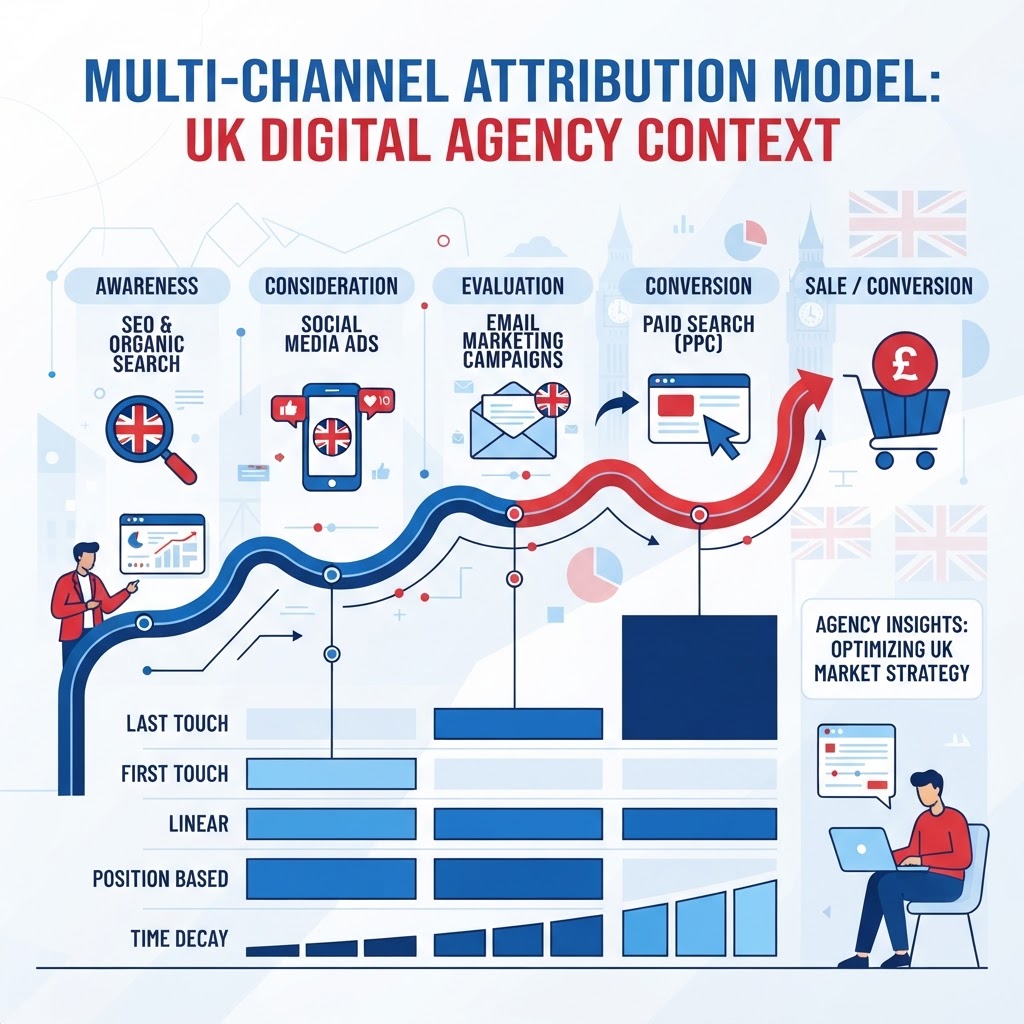
Multi-channel attribution is the process of identifying and assigning credit to every marketing touchpoint a customer interacts with before completing a conversion — whether that's a purchase, an enquiry, or a sign-up. Unlike single-touch models that hand all the credit to one channel, multi-channel attribution gives you a realistic picture of the entire customer journey.
For UK businesses, this matters enormously. The average British consumer encounters a brand across six or more touchpoints before making a buying decision. A customer might discover your brand through a Google search, follow you on Instagram, click a retargeting ad, open a promotional email, and finally convert after a direct visit to your website. If you only measure the last click, you'd credit the direct visit and completely ignore the organic search and social media activity that started the relationship.
"Businesses that adopt data-driven, multi-touch attribution models see up to 15–20% improvement in marketing efficiency — meaning the same budget drives more conversions simply by being allocated more intelligently." — Google Marketing Platform Research
Without accurate attribution, you risk defunding the channels that generate awareness and consideration — the very channels that feed conversions downstream.
The Most Common Attribution Models Explained
Before you can choose the right attribution model, you need to understand what's available. Each model reflects a different assumption about how customers make decisions.
Single-Touch Attribution Models
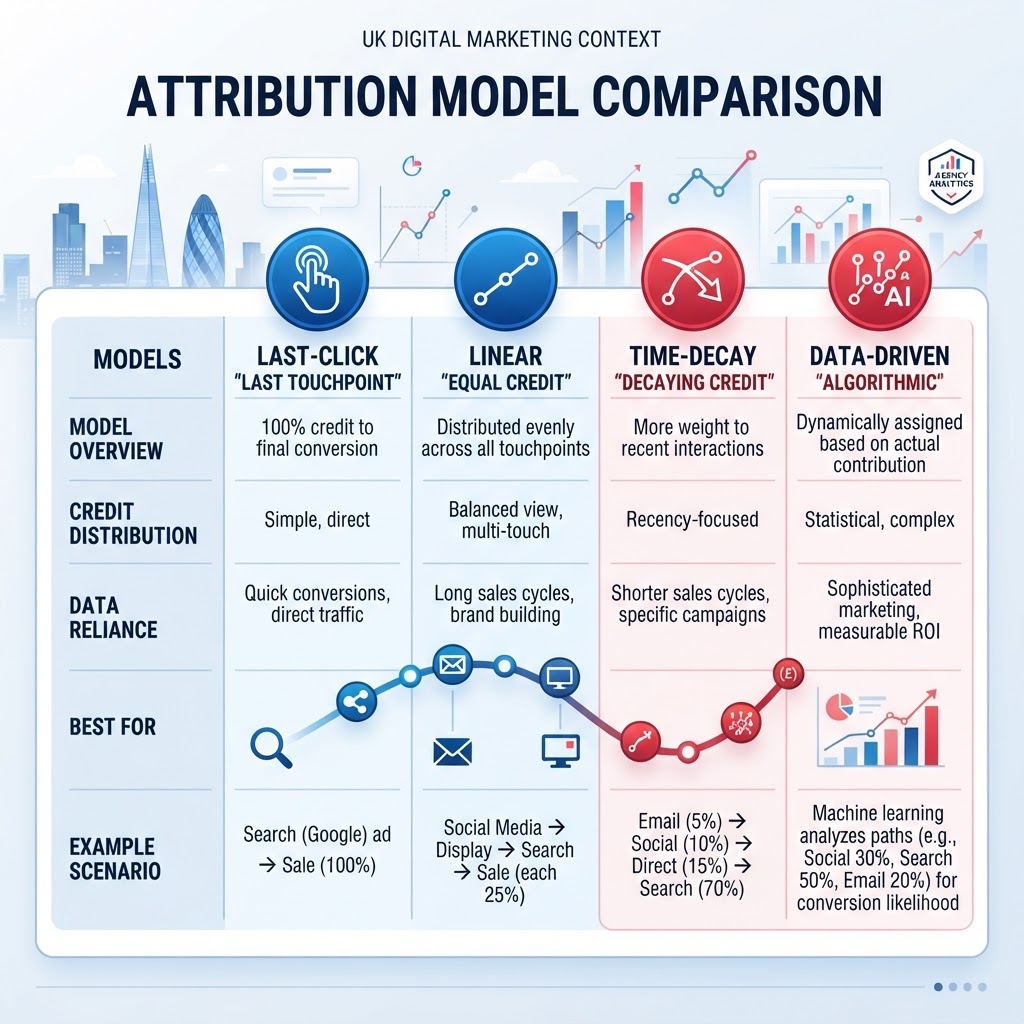
- Last-click attribution: Gives 100% of conversion credit to the final touchpoint before purchase. Simple but misleading — it ignores everything that built trust beforehand.
- First-click attribution: Credits the channel that first introduced the customer to your brand. Useful for awareness measurement, but ignores the nurturing process entirely.
Multi-Touch Attribution Models
- Linear attribution: Spreads credit equally across all touchpoints in the journey. A fairer starting point, but it treats a brief social impression the same as a detailed product page visit.
- Time-decay attribution: Gives more credit to touchpoints that occurred closer to the conversion. Logical for short sales cycles but can undervalue brand awareness efforts.
- Position-based (U-shaped) attribution: Assigns 40% credit each to the first and last touchpoints, distributing the remaining 20% across middle interactions. Popular with teams that value both acquisition and conversion.
- Data-driven attribution: Uses machine learning to assign credit based on the actual influence each touchpoint had on conversions. The gold standard — but requires sufficient data volume to work reliably.
For most UK businesses working with STEPS Solutions, we recommend starting with a position-based or time-decay model and graduating to data-driven attribution once you have the conversion volume to support it.
How to Set Up Multi-Channel Attribution Tracking in the UK
Accurate attribution depends entirely on clean, consistent tracking. Here's a practical setup process for UK businesses ready to move beyond guesswork.
Step 1: Implement GA4 with Enhanced Measurement
Google Analytics 4 (GA4) is now the standard analytics platform for UK businesses following the deprecation of Universal Analytics. GA4's event-based data model and built-in attribution reporting make it significantly better suited to multi-touch analysis than its predecessor. Ensure you have conversion events properly configured — not just pageviews.
Step 2: Use UTM Parameters Consistently
UTM parameters are the backbone of channel attribution. Every paid campaign, email newsletter, and social post should carry properly formatted UTM tags so GA4 can correctly categorise traffic sources. Inconsistent UTM usage is the single biggest cause of attribution errors we see at STEPS Solutions when auditing new client accounts.
Step 3: Connect Your Advertising Platforms
Link your Google Ads, Meta Ads, and any other paid channels directly to GA4. This allows you to compare platform-reported conversions against GA4's cross-channel view — and the discrepancies you'll find are often illuminating.
Step 4: Account for Offline Touchpoints
Many Yorkshire businesses operate both online and offline. If customers call your team, visit a showroom, or engage at a local event before converting online, consider offline conversion imports and call tracking tools to bring those interactions into your attribution data.
Common Attribution Mistakes UK Businesses Make
Even well-resourced marketing teams make attribution errors that skew their data and distort decisions. The most frequent issues we identify when working with clients across Halifax, Yorkshire, and the wider UK include:
- Relying solely on platform-native reporting: Google Ads will claim credit for every conversion it touched. So will Meta. Platform data is inherently biased — you need a neutral third-party view from GA4 or a dedicated attribution tool.
- Ignoring view-through conversions: Display and social ads often influence decisions even when users don't click. Dismissing view-through data entirely undervalues brand awareness channels.
- Failing to segment by customer journey length: A B2B customer with a 90-day decision cycle needs a completely different attribution model than a consumer making an impulse purchase. Applying one model to all journeys produces misleading averages.
- Not accounting for cookie consent limitations: Under UK GDPR and the Privacy and Electronic Communications Regulations (PECR), a significant proportion of your UK visitors may decline tracking cookies. If your attribution model only captures opted-in users, it may systematically misrepresent certain demographics.
- Treating attribution as a one-time project: Customer behaviour shifts seasonally, competitively, and culturally. Attribution models need regular review — at minimum quarterly for most businesses.
Practical Attribution Strategies for Local and Regional UK Businesses
National brands aren't the only ones who benefit from sophisticated attribution. Local and regional businesses — the kind of growth-focused companies STEPS Solutions regularly partners with across Halifax and Yorkshire — can use attribution data to make highly targeted improvements.
For example, a local professional services firm might discover through attribution analysis that organic search consistently drives first touchpoints while email remarketing drives the final conversion. That insight justifies continued investment in both channels rather than cutting email spend because it has a low first-click share.
Similarly, a regional e-commerce business might find that local SEO content drives a disproportionately high share of first interactions in its home region, making the case for increased content investment targeting Yorkshire search intent. These are the kinds of granular, actionable insights that proper multi-channel attribution makes possible.

Key Takeaways
- Multi-channel attribution assigns conversion credit across all marketing touchpoints, not just the last click — giving UK businesses a truthful view of their customer journeys.
- There is no single "correct" attribution model — the best choice depends on your sales cycle length, data volume, and business goals.
- GA4 with consistent UTM tagging and connected ad platforms is the practical foundation for attribution tracking for most UK businesses.
- UK-specific considerations — including GDPR compliance, cookie consent rates, and offline customer interactions — must be built into your attribution strategy.
- Attribution is an ongoing process, not a one-time setup; regular review is essential as channels, behaviour, and competition evolve.
- Local and regional businesses in areas like Halifax and Yorkshire can leverage attribution data to make targeted, high-impact budget decisions that national averages would obscure.
- Working with a specialist digital agency like STEPS Solutions can accelerate the implementation of accurate attribution and translate data into concrete marketing improvements.
Frequently Asked Questions
What is multi-channel attribution in digital marketing?
Multi-channel attribution is the method of distributing conversion credit across every marketing touchpoint a customer engages with before completing a desired action — such as a purchase or enquiry. Rather than crediting only the final click or the first interaction, multi-channel attribution models reflect the full customer journey, enabling businesses to understand the true contribution of channels like organic SEO, paid search, social media, and email.
Which attribution model is best for UK small businesses?
For most UK small businesses, a position-based (U-shaped) attribution model offers a practical starting point. It balances the value of brand awareness (first touch) and conversion (last touch) without requiring the large data volumes that data-driven attribution needs to be statistically reliable. As your conversion volume grows, upgrading to data-driven attribution within GA4 will provide greater accuracy. Consulting with a UK digital agency like STEPS Solutions can help you choose and implement the right model for your specific business context.
How does UK GDPR affect multi-channel attribution tracking?
UK GDPR and PECR require that businesses obtain informed consent before placing non-essential tracking cookies on users' devices. In practice, this means a portion of your UK website visitors will decline cookies, creating gaps in your attribution data. To mitigate this, businesses should use server-side tracking where appropriate, consider modelled conversion data within GA4, and ensure their attribution analysis accounts for the likelihood that certain user segments are systematically underrepresented in opted-in data.
What tools do UK businesses use for multi-channel attribution?
The most widely used tools for multi-channel attribution among UK businesses include Google Analytics 4 (GA4) for cross-channel journey analysis, Google Ads and Meta Ads Manager for platform-level data, and UTM parameter tracking for campaign-level source identification. More advanced options include dedicated attribution platforms such as Rockerbox, Triple Whale (popular in e-commerce), and Northbeam. For most businesses working with a UK digital agency, GA4 properly configured with connected ad platforms provides a strong, cost-effective foundation.
How can local businesses in Yorkshire benefit from multi-channel attribution?
Local and regional businesses in Yorkshire can use multi-channel attribution to identify which specific channels drive awareness versus conversion within their target geographic area. For example, attribution data might reveal that local SEO content generates the majority of first interactions from Yorkshire-based prospects, while email follow-up sequences close the sale — justifying investment in both rather than cutting one based on incomplete last-click data. This level of insight allows regional businesses to compete more effectively with national brands by allocating budget precisely where it has the greatest local impact.