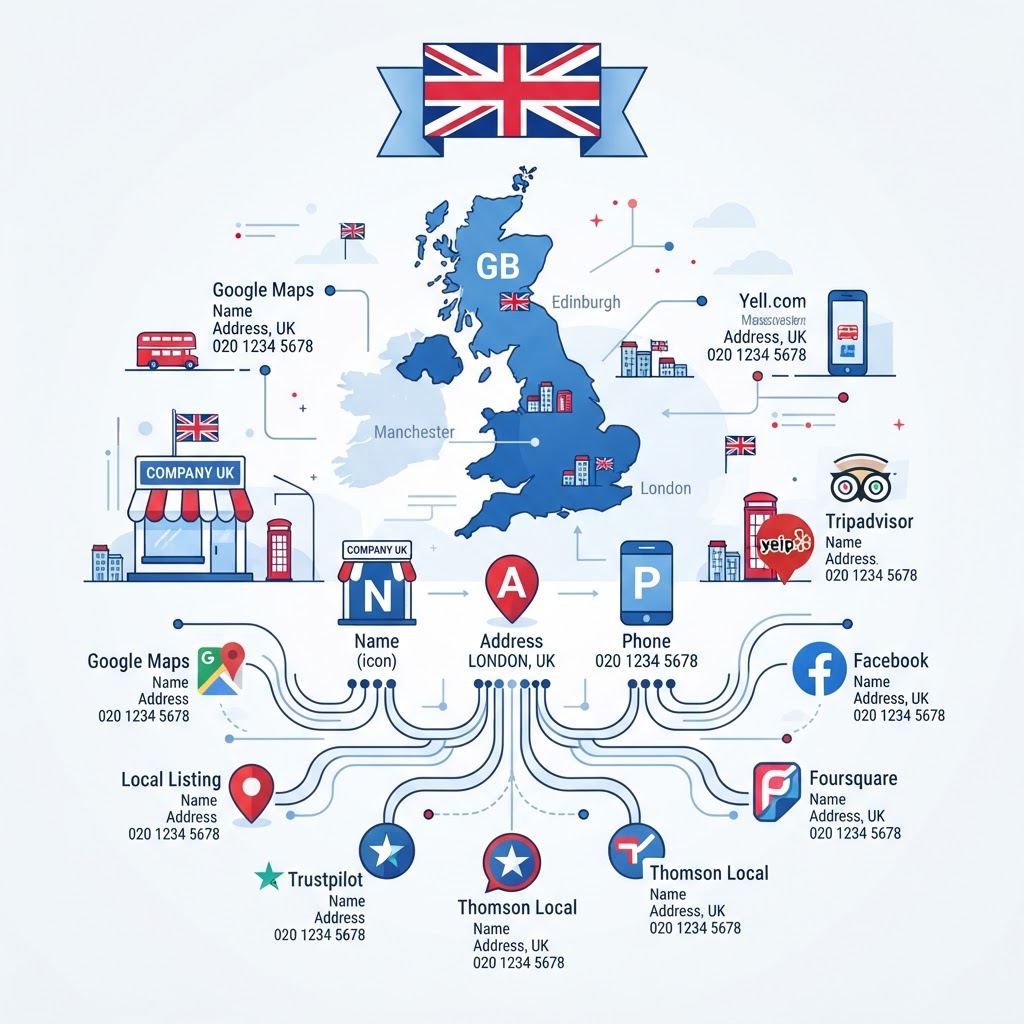
For any UK business trying to win local customers online, few factors are as foundational — yet as frequently overlooked — as NAP consistency and local citations. NAP stands for Name, Address, and Phone number: the three pieces of business information that appear across directories, review platforms, and search engines. When these details are consistent, search engines trust your business. When they conflict, that trust erodes — and so does your local search visibility. At STEPS Solutions, working with businesses across Halifax, Yorkshire, and beyond, we see the impact of citation errors on local rankings every single day. This guide explains everything UK businesses need to know to get it right.
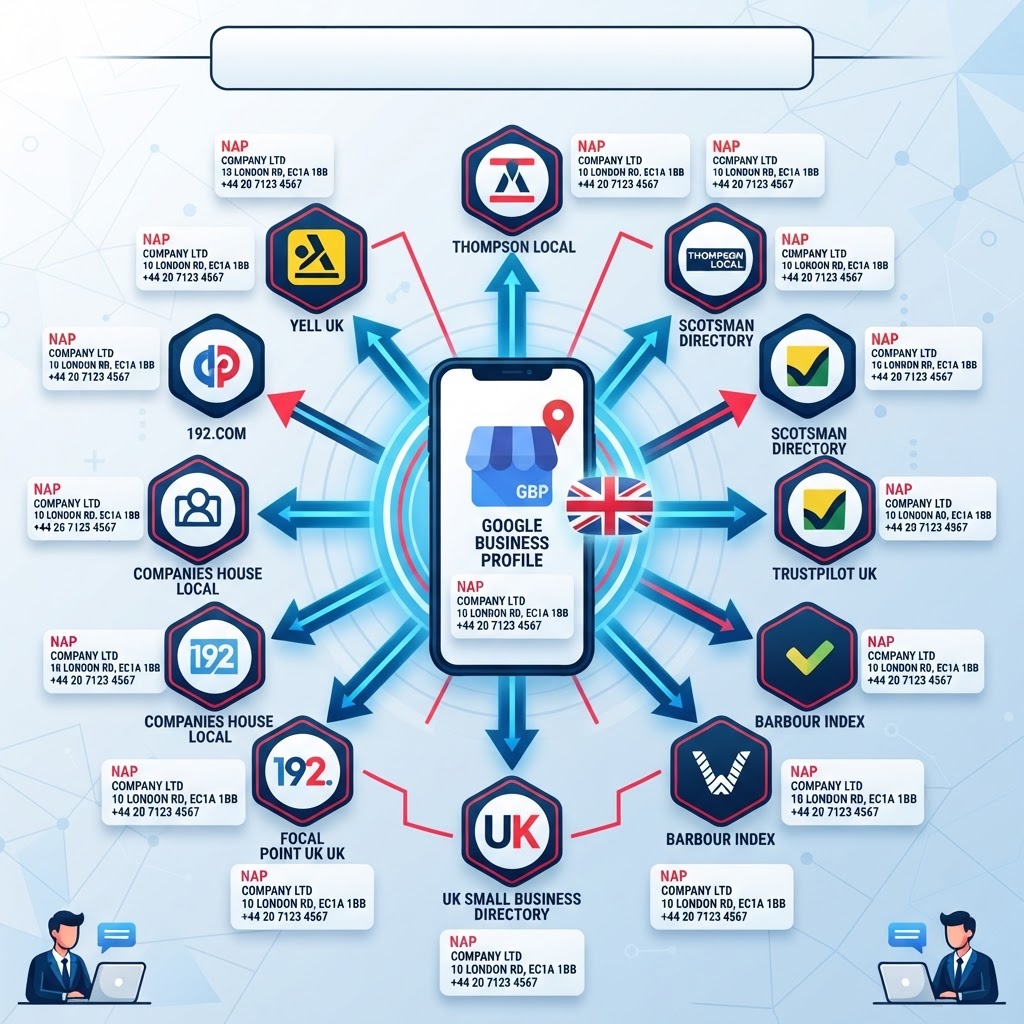
What Is NAP Consistency and Why Does It Matter?
NAP consistency means your business name, address, and phone number are identical — not just similar — across every online platform where your business appears. This includes your own website, Google Business Profile, Bing Places, Yell.com, Yelp UK, Thomson Local, and dozens of other directories.
Search engines like Google use these data points as signals to verify that a business is legitimate and accurately located. When Google finds the same NAP information repeated across multiple trusted sources, it increases its confidence in your business details and rewards you with stronger visibility in local search results and the coveted Local Pack — the map-based results that appear at the top of location-based searches.
"Inconsistent NAP data is one of the most common and damaging local SEO mistakes we find during audits. A single digit wrong in a phone number, or 'Ltd' missing from a business name, can silently suppress rankings for months." — STEPS Solutions Local SEO Team
Even minor inconsistencies cause problems. For example, listing your business as "STEPS Solutions Ltd" on your website but "Steps Solutions" on Yell.com, or using an old phone number on a directory you forgot you registered with years ago, introduces conflicting signals that confuse search engine algorithms.
What Are Local Citations?
A local citation is any online mention of your business's NAP information. Citations can be structured — appearing in a formal business directory listing with dedicated fields for name, address, and phone — or unstructured, such as a mention of your business in a news article, blog post, or community website.
Structured Citations
Structured citations appear on dedicated business listing platforms. For UK businesses, the most important structured citation sources include:
- Google Business Profile — the single most important citation for local SEO
- Bing Places for Business — often underutilised but still a significant ranking signal
- Apple Maps — increasingly important as Siri and Apple devices dominate UK smartphone use
- Yell.com — the UK's leading business directory
- Thomson Local — widely used across England and Wales
- Checkatrade and Rated People — essential for trades and home services
- Trustpilot — critical for credibility and citation authority
- Facebook Business Page — a trusted social citation source
Unstructured Citations
Unstructured citations include press mentions, local news features, partner websites, and blog posts that reference your business. A mention in the Yorkshire Post or a local Halifax community blog carries genuine citation value, particularly because of its geographic relevance.
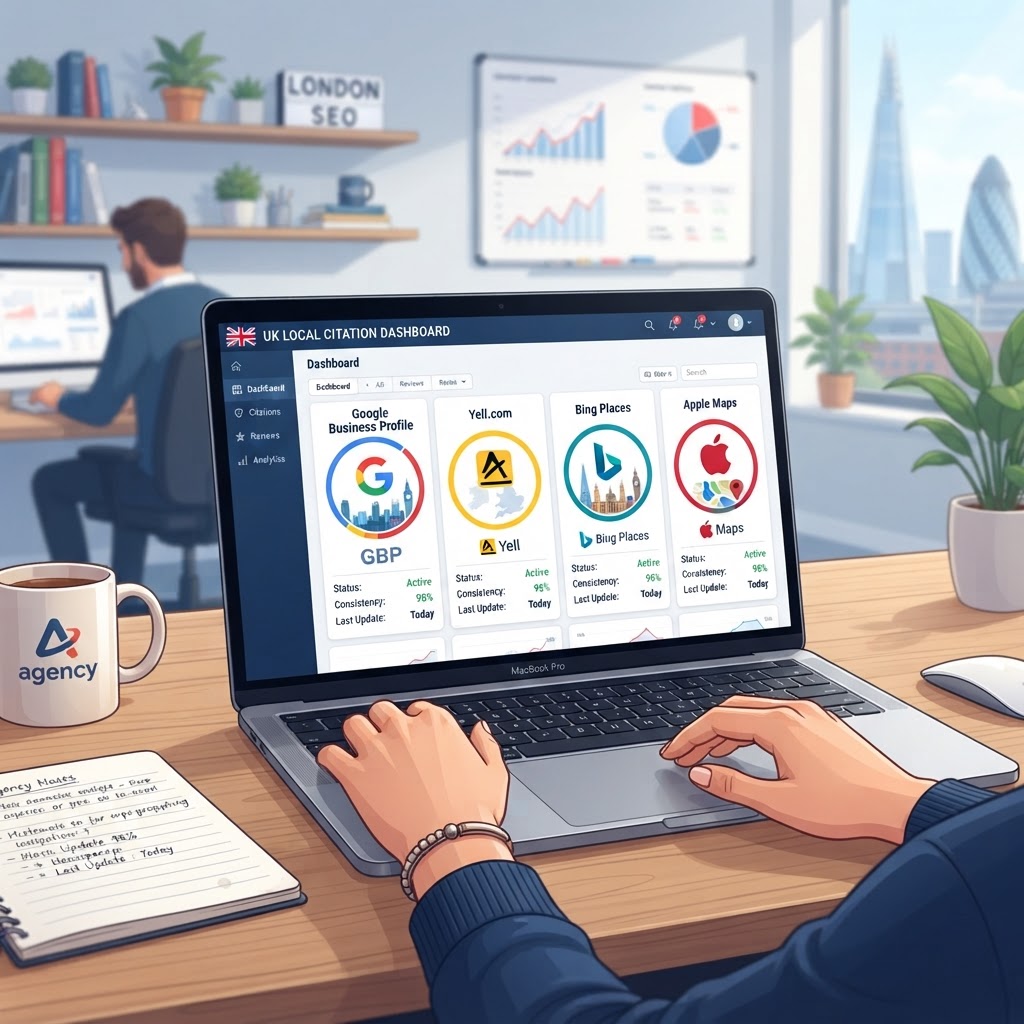
How NAP Inconsistency Damages Your Local SEO
The consequences of poor NAP consistency go beyond a slight drop in rankings. Here is how citation errors actively harm local search performance for UK businesses:
- Reduced Local Pack visibility: Google's algorithm deprioritises businesses with conflicting location data because it cannot confidently present them to searchers.
- Lost customer trust: When a potential customer finds two different phone numbers for your business, they question whether you are still trading.
- Diluted citation authority: Duplicate listings with different NAP data split the ranking power that should be consolidated behind one authoritative listing.
- AI and voice search errors: Language models and voice assistants like Alexa, Siri, and Google Assistant draw business information from citation databases. Inconsistent data means your business may be misrepresented or excluded entirely from AI-generated answers.
- Wasted marketing spend: Driving paid traffic to a business that cannot be found or trusted in local search undermines every other investment you make.
How to Audit and Fix Your NAP Consistency
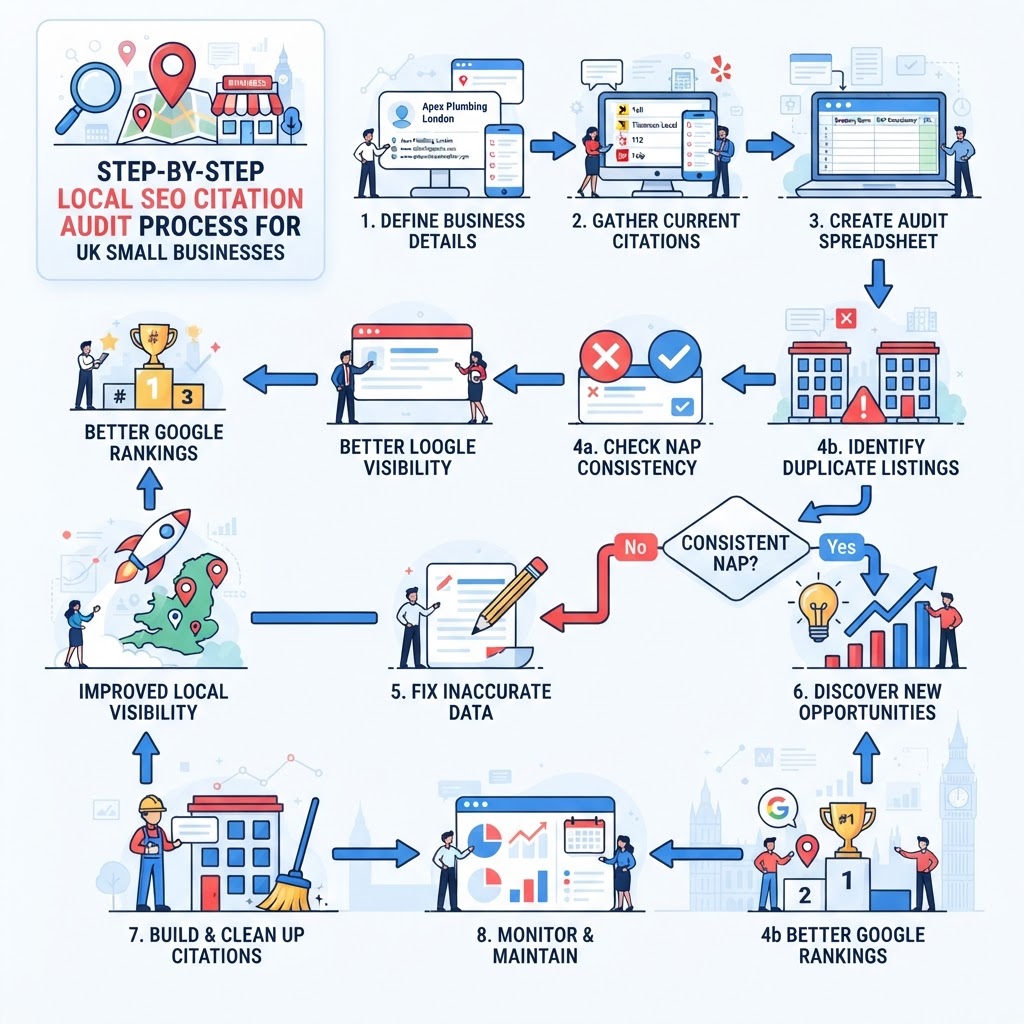
Before building new citations, UK businesses should audit what already exists. Follow this process:
Step 1: Define Your Master NAP
Decide on the exact, canonical version of your business name, address, and phone number. This becomes your master NAP. Every listing must match it precisely. Consider details such as whether to include "Ltd" or "Limited", whether to spell out "Street" or abbreviate to "St", and which phone number format to use consistently (e.g., 01422 000000 rather than +44 1422 000000 on most UK directories).
Step 2: Search for Existing Listings
Search Google for your business name combined with your town or postcode. Also use tools such as BrightLocal, Whitespark, or Moz Local to surface citation sources you may have forgotten about. Pay particular attention to old addresses if your business has moved.
Step 3: Correct Inconsistencies and Remove Duplicates
Log into each platform and update incorrect information to match your master NAP. Where duplicate listings exist, request their removal. On platforms that do not allow direct editing, use their support or reporting tools to flag the issue.
Step 4: Build New Citations on Authoritative UK Directories
Once existing citations are clean, expand your footprint. Prioritise directories with strong domain authority and genuine UK traffic. Local and industry-specific directories — such as a Yorkshire Chamber of Commerce listing or a trade association directory — carry additional geographic and topical relevance.
Local Citations and the Rise of AI Search
The importance of citations has grown sharply with the rise of AI-powered search and generative engine results. When someone asks Google's AI Overview, ChatGPT, or Perplexity "who are the best web designers in Halifax?" these systems pull structured data from across the web — including citation databases — to generate their answers.
Businesses with clean, consistent, and widely distributed NAP data are significantly more likely to be surfaced by AI models. This is why GEO (Generative Engine Optimisation) now reinforces traditional local SEO best practice rather than replacing it. The fundamentals — accurate data, authoritative citations, trustworthy listings — remain the bedrock of visibility whether the search is typed into Google or spoken to an AI assistant.
At STEPS Solutions, we integrate citation building and NAP management into our local SEO strategies precisely because clean citation data feeds not only traditional search rankings but also the AI systems that are increasingly mediating how people discover local businesses across Yorkshire and the UK.
Key Takeaways
- NAP consistency — identical Name, Address, and Phone number across all platforms — is a foundational local SEO signal.
- Local citations are any online mentions of your business details; structured (directory) and unstructured (editorial) citations both carry value.
- Inconsistent NAP data reduces Google Local Pack visibility, damages customer trust, and causes AI search tools to misrepresent your business.
- Always define a master NAP before building or correcting citations, ensuring every detail is standardised.
- UK businesses should prioritise Google Business Profile, Bing Places, Apple Maps, Yell.com, and industry-specific directories.
- With AI-driven search growing rapidly, clean citation data is now essential for GEO and AEO as well as traditional SEO.
- Regular citation audits — at minimum annually, or whenever business details change — are essential maintenance, not a one-time task.
Frequently Asked Questions
What is NAP consistency in local SEO?
NAP consistency means your business Name, Address, and Phone number are identical across every online platform — including your website, Google Business Profile, and all directories. Consistent NAP data helps search engines verify your business details and improves your visibility in local search results and Google's Local Pack.
How many citations does a UK small business need?
There is no fixed number, but UK small businesses should aim to be listed accurately on at least 20–30 authoritative directories, starting with Google Business Profile, Bing Places, Apple Maps, Yell.com, and any industry-specific or local directories relevant to their sector and location. Quality and consistency matter more than volume.
Does NAP consistency affect AI search results?
Yes. AI assistants and generative search tools like Google AI Overviews, Siri, and ChatGPT pull business information from citation databases across the web. If your NAP data is inconsistent or outdated, AI systems may present incorrect details about your business or exclude it from AI-generated local recommendations entirely.
What are the best local citation sources for UK businesses?
The most important UK citation sources are Google Business Profile, Bing Places, Apple Maps, Yell.com, Thomson Local, Facebook Business, and Trustpilot. For trades and services, Checkatrade and Rated People are highly valuable. Businesses should also seek listings in local directories relevant to their area, such as regional Chamber of Commerce sites.
How often should UK businesses audit their local citations?
UK businesses should audit their citations at least once a year, and immediately whenever business details change — such as a new address, phone number, or business name. Proactive auditing prevents outdated information from quietly damaging local search rankings and misleading potential customers.