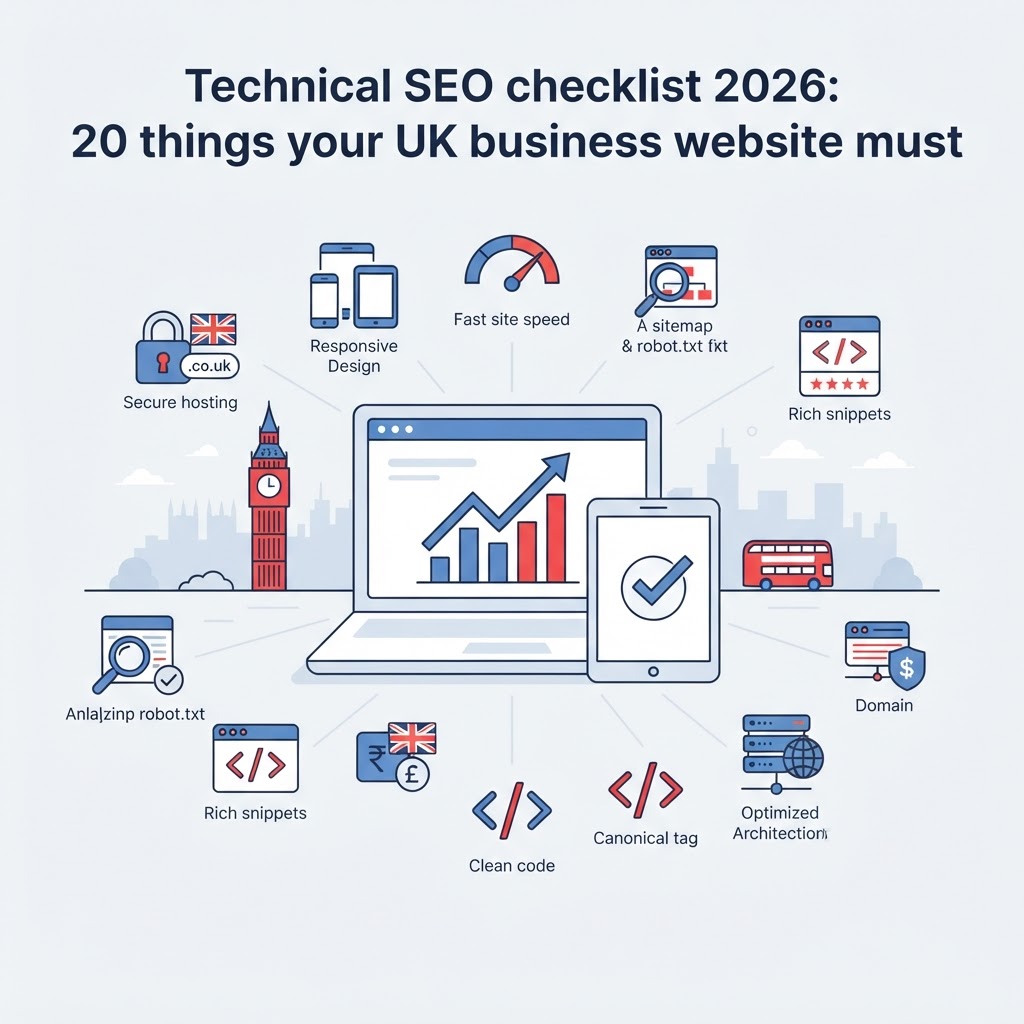
If your UK business website isn't technically sound, no amount of great content or social media activity will save your search rankings. In 2026, technical SEO has become more complex and more critical than ever — with Google's AI-driven search, Core Web Vitals updates, and the rise of generative AI tools all raising the bar for what a well-optimised website looks like. At STEPS Solutions in Halifax, West Yorkshire, we audit dozens of UK business websites every year, and the same technical gaps keep appearing. This checklist covers the 20 essential technical SEO requirements your website must meet in 2026 — whether you're a local business in Yorkshire or a national brand serving customers across the UK.
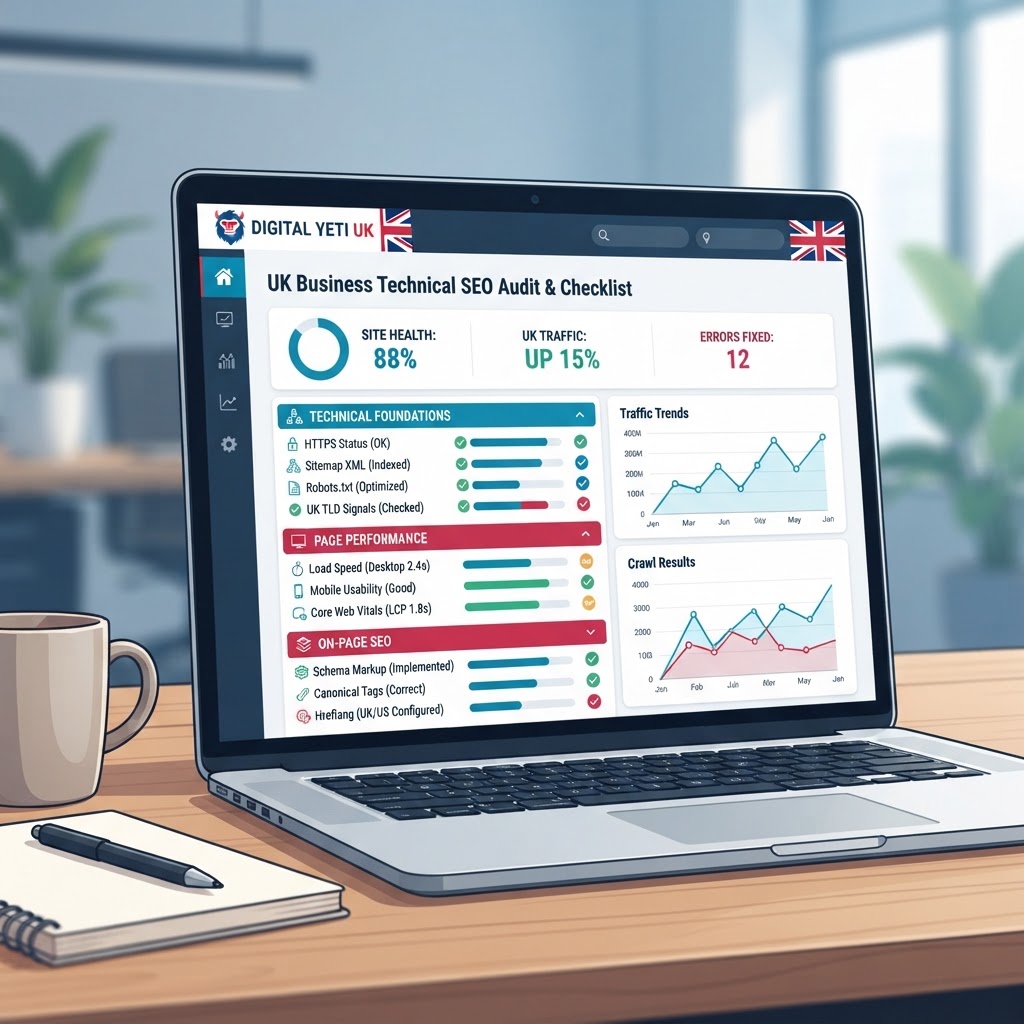
Why Technical SEO Matters More Than Ever in 2026
Technical SEO is the foundation of every successful digital marketing strategy. Without it, search engines struggle to crawl, index, and rank your pages — no matter how good your content is. In 2026, the stakes are higher because Google's Search Generative Experience (SGE) and AI Overviews now pull structured, authoritative content directly into search results. Websites that are technically clean and well-structured are far more likely to be cited by AI models and featured in answer engines.
"Over 60% of websites audited by technical SEO professionals have critical crawlability or indexation issues that directly suppress their organic visibility." — Search Engine Journal, 2025 State of SEO Report
For UK businesses competing in increasingly AI-influenced search results, getting the technical foundations right is non-negotiable. Here is the definitive 2026 checklist.
Section 1: Crawlability and Indexation (Items 1–5)
1. A Clean, Accurate robots.txt File
Your robots.txt file tells search engine crawlers which pages to access and which to ignore. A misconfigured robots.txt can accidentally block your entire site from Google. Audit this file regularly to ensure you are not disallowing critical pages, CSS files, or JavaScript resources.
2. An XML Sitemap That Is Submitted and Up to Date
Your XML sitemap should list every indexable page on your website and be submitted to Google Search Console. In 2026, dynamic sitemaps that update automatically when you publish new content are considered best practice. Remove any 404 pages, redirected URLs, or noindexed pages from your sitemap immediately.
3. Correct Use of Canonical Tags
Duplicate content is one of the most common issues we identify at STEPS Solutions during website audits. Canonical tags tell Google which version of a page is the definitive one, preventing diluted rankings. Every page should have a self-referencing canonical tag, and paginated content, filtered category pages, and print versions must be canonicalised correctly.
4. No Orphan Pages
An orphan page has no internal links pointing to it, meaning crawlers may never find it. Use a site audit tool to identify orphan pages and integrate them into your site's internal linking structure.
5. Google Search Console Is Set Up and Actively Monitored
Google Search Console is the single most important free tool for monitoring your site's technical health. Ensure it is set up, your preferred domain version is verified, and you are reviewing crawl errors, coverage reports, and Core Web Vitals data at least monthly.

Section 2: Site Speed and Core Web Vitals (Items 6–10)
6. Largest Contentful Paint (LCP) Under 2.5 Seconds
LCP measures how quickly the largest visible element on a page loads. Google's threshold for a "good" score is under 2.5 seconds. Slow LCP is typically caused by unoptimised images, slow server response times, or render-blocking resources.
7. Interaction to Next Paint (INP) Under 200 Milliseconds
In 2024, Google replaced First Input Delay with Interaction to Next Paint (INP) as a Core Web Vital. INP measures how responsive your site is to user interactions. Scores under 200ms are considered good. Bloated JavaScript is the most common culprit for poor INP scores.
8. Cumulative Layout Shift (CLS) Under 0.1
CLS measures visual stability — how much your page layout shifts unexpectedly as it loads. A score under 0.1 is the Google benchmark. Common causes include images without defined dimensions, dynamically injected content, and web fonts loading without fallback sizing.
9. Images Are Compressed and Served in Next-Gen Formats
Images remain the single biggest drag on page speed for most UK business websites. All images should be compressed, sized correctly for their display dimensions, and served in WebP or AVIF format where supported. Lazy loading should be applied to below-the-fold images.
10. Hosting That Delivers Fast Time to First Byte (TTFB)
TTFB — the time it takes your server to start responding — should be under 800ms. Cheap shared hosting is the leading cause of poor TTFB for small and medium-sized UK businesses. Upgrading to managed hosting or a CDN-backed solution can produce immediate improvements.
Section 3: Mobile, Security, and Accessibility (Items 11–15)
11. Fully Mobile-First Design and Functionality
Google indexes the mobile version of your site first. In 2026, a mobile-first website is not a nice-to-have — it is a fundamental ranking requirement. Every page must be fully functional, readable, and fast on mobile devices. Test with Google's Mobile-Friendly Test and real device testing.
12. HTTPS Across Every Page
Your entire website must be served over HTTPS. Any pages still loading over HTTP will trigger browser security warnings, damage user trust, and suppress rankings. Check that your SSL certificate is valid, not expiring, and that no mixed content warnings exist.
13. Structured Data Markup (Schema.org)
Structured data is one of the most powerful technical SEO tools available to UK businesses in 2026. Implementing relevant Schema.org markup — such as LocalBusiness, FAQPage, Article, Product, and BreadcrumbList — helps Google and AI models understand your content and qualify your pages for rich results and AI-generated answers.
14. Clean URL Structure
URLs should be short, descriptive, lowercase, and hyphen-separated. Avoid dynamic parameter-heavy URLs where possible. A logical URL hierarchy (e.g. /services/local-seo/) helps both users and crawlers understand your site structure.
15. Accessibility Compliance (WCAG 2.2)
Web accessibility is both an ethical requirement and an SEO signal. Ensuring your site meets WCAG 2.2 AA standards — including proper heading hierarchy, alt text for images, sufficient colour contrast, and keyboard navigability — improves usability for all visitors and signals quality to search engines.
Section 4: Advanced Technical SEO for 2026 (Items 16–20)
16. Hreflang Tags for Multilingual or Multi-Regional Sites
If your UK business serves customers in multiple regions or languages, hreflang tags are essential. They tell Google which language and regional version of a page to serve to which audience, preventing international duplicate content issues.
17. Pagination Handled Correctly
E-commerce sites, blogs, and resource libraries often have paginated content. In 2026, the recommended approach is to use self-referencing canonicals on paginated pages and ensure your navigation passes link equity through clearly structured, crawlable links.
18. JavaScript Rendering Is Not Blocking Critical Content
If your site relies heavily on JavaScript to render content, Google must be able to render that JavaScript to index it. Use server-side rendering (SSR) or static site generation (SSG) for critical content where possible, and test how Googlebot sees your pages using the URL Inspection tool in Search Console.
19. Internal Linking Strategy Is Intentional and Hierarchical
A strong internal linking structure distributes page authority across your site, helps users navigate, and signals to Google which pages are most important. Every key service or product page should be linked from multiple relevant locations across your site, including the homepage, navigation, and contextually within blog content.
20. Regular Technical Audits Are Scheduled
Technical SEO is not a one-time task. Websites accumulate errors over time as content is added, plugins are updated, and CMS changes are made. STEPS Solutions recommends scheduling a comprehensive technical audit at least quarterly — and using tools like Screaming Frog, Ahrefs, or Semrush to monitor crawl health on an ongoing basis.

Key Takeaways
- Crawlability and indexation are the foundation — fix robots.txt, sitemaps, and canonical issues first.
- Core Web Vitals (LCP, INP, CLS) are direct Google ranking signals — every UK business website must meet the "good" thresholds.
- Structured data markup is essential for visibility in AI-generated search results and rich snippets in 2026.
- HTTPS, mobile-first design, and accessibility are non-negotiable baseline requirements, not optional extras.
- Technical SEO is ongoing — regular audits prevent issues from compounding and protect your search visibility.
- Businesses in Halifax, Yorkshire, and across the UK that invest in technical SEO foundations consistently outperform competitors who focus only on content.
If any of these 20 items are missing from your website, you are leaving organic search visibility — and potential revenue — on the table. The team at STEPS Solutions in Halifax, West Yorkshire specialises in comprehensive technical SEO audits and implementations for UK businesses of all sizes. Getting the technical foundations right is the highest-return investment you can make in your digital presence in 2026.
Frequently Asked Questions
What is a technical SEO checklist and why does my UK business need one?
A technical SEO checklist is a structured list of website requirements that ensure search engines can crawl, index, and rank your pages effectively. UK businesses need one because technical issues — such as slow page speed, missing structured data, or crawl errors — directly suppress search rankings regardless of how good the website's content is. Addressing technical SEO is the fastest way to improve organic visibility without creating new content.
What are the most important technical SEO factors in 2026?
The most important technical SEO factors in 2026 are Core Web Vitals (LCP, INP, and CLS), mobile-first design, HTTPS security, structured data markup (Schema.org), correct canonicalisation, a valid XML sitemap, and a clean internal linking structure. Additionally, ensuring your site's content is accessible to JavaScript rendering by Googlebot and implementing Schema markup for AI search visibility have become critical priorities.
How often should a UK business conduct a technical SEO audit?
UK businesses should conduct a full technical SEO audit at least once per quarter. Websites change frequently — new pages are added, plugins are updated, and redirects accumulate — all of which can introduce technical errors. Using tools like Google Search Console, Screaming Frog, or Ahrefs for ongoing monitoring between audits is also recommended to catch critical issues as they arise.
Does structured data markup help with AI search results?
Yes. Structured data markup using Schema.org vocabulary helps AI-powered search features — including Google's AI Overviews and answer engines — better understand and categorise your content. Pages with relevant Schema markup, such as FAQPage, LocalBusiness, or Article schema, are significantly more likely to be cited in AI-generated answers and featured in rich search results.
Can a small business in Yorkshire improve its SEO with technical fixes alone?
Technical SEO fixes can produce significant ranking improvements for small businesses in Yorkshire, especially if the site has existing issues such as slow page speed, crawl errors, or missing Schema markup. However, technical SEO works best as part of a complete strategy that also includes quality content, local SEO optimisation, and link building. Agencies like STEPS Solutions in Halifax provide integrated technical and local SEO services tailored to Yorkshire and UK small businesses.