
The way people search for local businesses is undergoing a fundamental shift. In 2026, voice search and "near me" queries are no longer a niche behaviour — they are the dominant mode of discovery for millions of UK consumers using smartphones, smart speakers, and AI assistants. For businesses in Halifax, across Yorkshire, and throughout the UK, understanding how these searches work and how to optimise for them is no longer optional. It is the difference between being found and being invisible.
What Is Voice Search and Why Does It Matter for Local SEO in 2026?
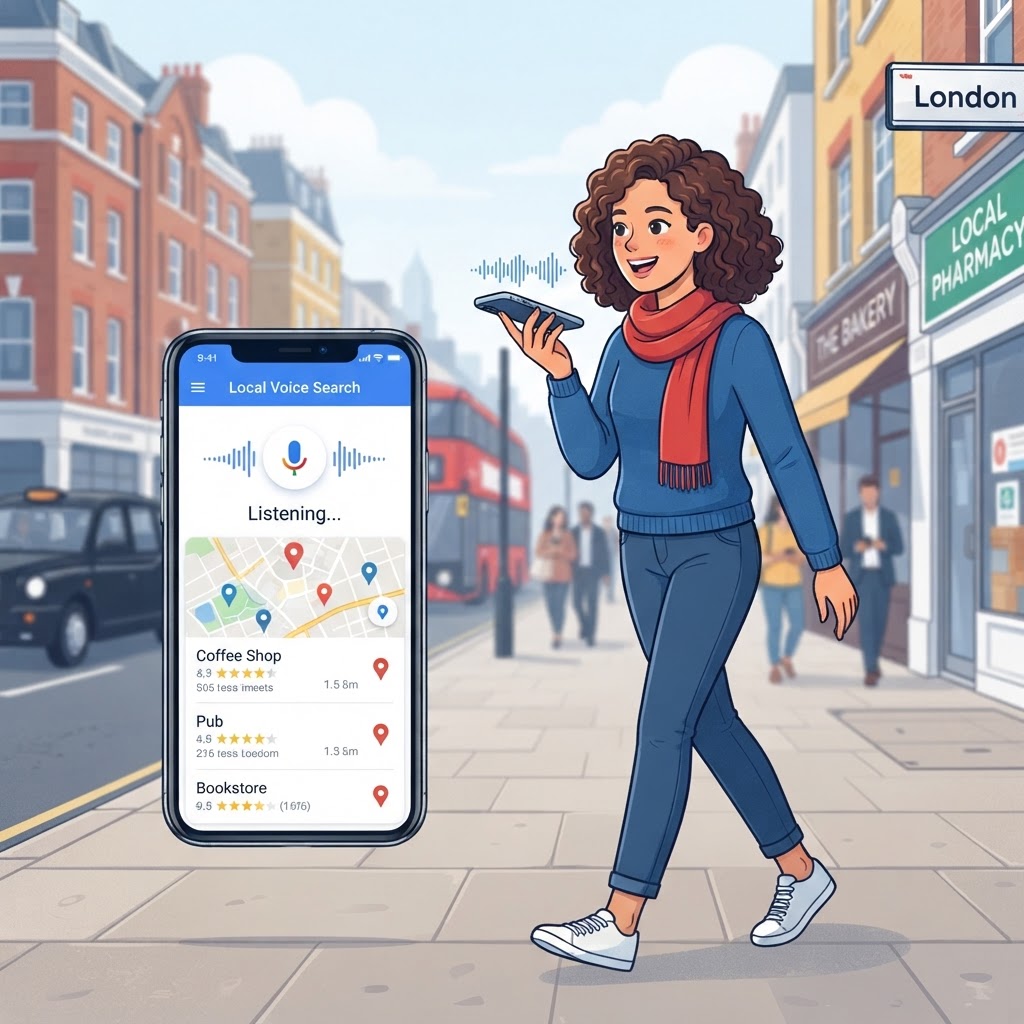
Voice search is the act of speaking a query aloud to a device — whether that is Google Assistant, Apple Siri, Amazon Alexa, or an AI-powered browser — rather than typing it. What makes voice search so significant for local SEO is that the vast majority of voice queries have clear local intent. Users are not researching abstract topics; they are looking for something nearby, right now.
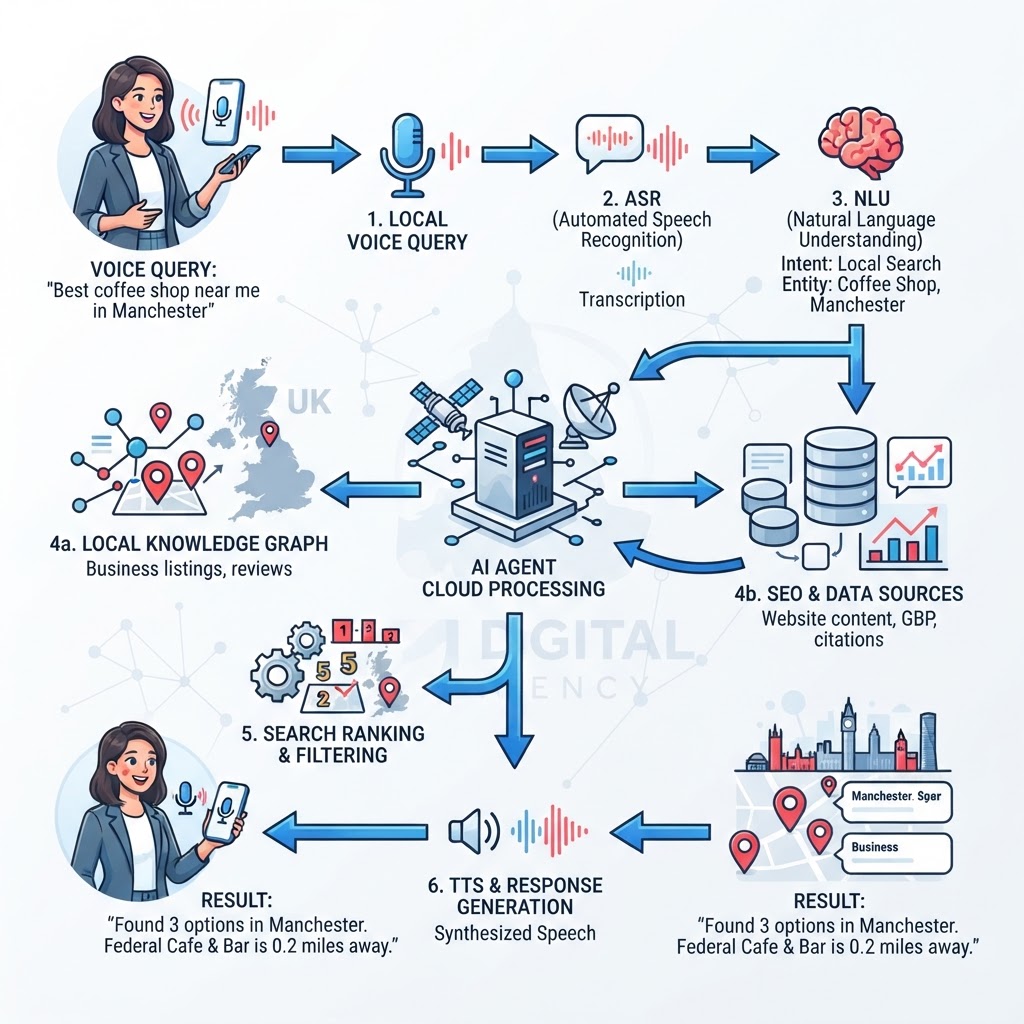
In 2026, the integration of large language models (LLMs) into search engines has made voice responses smarter, more conversational, and more context-aware than ever before. When someone says "find me a web designer near me," the AI behind that query does not just return a list of links — it synthesises information from trusted sources and delivers a direct, spoken answer. If your business is not optimised to be that answer, a competitor will be.
"Over 58% of consumers used voice search to find local business information in the past year, and that figure continues to climb as AI assistants become embedded in everyday devices." — BrightLocal Local Consumer Review Survey
How "Near Me" Searches Have Evolved in 2026
The phrase "near me" was once a novelty. Today, it is one of the most searched modifiers in local SEO, and its usage has matured significantly. Here is what has changed in 2026 that every UK business owner needs to understand:
AI-Powered Contextual Understanding
Modern search engines and AI assistants no longer rely solely on exact keyword matching. Thanks to advances in natural language processing (NLP), a query like "where can I get my website sorted out in Halifax" will be understood as equivalent to "web development agency Halifax." This means businesses must optimise for conversational intent, not just rigid keyword phrases.
Zero-Click and Spoken Results
A growing proportion of voice search results deliver a zero-click outcome — meaning the AI answers the query directly without the user ever visiting a website. This makes it critical to have your business information structured in a way that AI models can extract and cite confidently. This is the core principle of Generative Engine Optimisation (GEO) and Answer Engine Optimisation (AEO), disciplines that are now as important as traditional SEO.
Hyperlocal Signals Are More Important Than Ever
Search algorithms in 2026 place enormous weight on hyperlocal relevance. Proximity, Google Business Profile completeness, local citations, and on-page location signals all contribute to whether your business surfaces in a voice result. For businesses in West Yorkshire — from Halifax town centre to Huddersfield, Brighouse, and beyond — getting these signals right is the foundation of local visibility.
How to Optimise Your Business for Voice Search and "Near Me" Queries
Optimising for voice search is a distinct discipline from traditional SEO, but it builds on the same foundations. At STEPS Solutions, we help Halifax and Yorkshire businesses implement strategies that work for both human searchers and AI-powered assistants. Here are the essential steps:
1. Claim and Fully Optimise Your Google Business Profile
Your Google Business Profile (GBP) is the single most important asset for local voice search. Ensure that every field is completed accurately, including your business category, opening hours, services, location, and a keyword-rich business description. Add high-quality photos regularly and respond to all reviews — these signals tell Google your listing is active and trustworthy.
2. Use Conversational, Question-Based Content
Voice queries are phrased as natural questions: "Who is the best SEO agency in Halifax?" or "What digital marketing services are available near me?" Your website content should mirror this conversational register. Create dedicated FAQ pages, blog posts that answer specific questions, and service pages that use long-tail, question-format keywords naturally within the copy.
3. Implement Local Schema Markup
Structured data (Schema.org markup) tells search engines exactly what your business does, where it is located, and what it offers. For local businesses, implementing LocalBusiness schema — including your address, telephone number, opening hours, and service area — is essential for appearing in AI-generated answers and voice results.
4. Build Consistent Local Citations
Ensure your NAP (Name, Address, Phone number) data is consistent across every directory: Yell, Yelp, Bing Places, Apple Maps, Trustpilot, and industry-specific directories. Inconsistencies confuse AI systems and can suppress your visibility in local results.
5. Optimise for Mobile Speed and Core Web Vitals
The overwhelming majority of voice searches happen on mobile devices. If your website is slow, poorly structured, or difficult to navigate on a smartphone, search engines will deprioritise it. Achieving strong Core Web Vitals scores — particularly Largest Contentful Paint (LCP) and Interaction to Next Paint (INP) — directly supports your voice search rankings.
The Role of GEO and AEO in Voice Search Success
As AI assistants increasingly act as the gatekeepers between consumers and businesses, two disciplines have risen to prominence alongside traditional SEO: Generative Engine Optimisation (GEO) and Answer Engine Optimisation (AEO).
- GEO focuses on making your content citable and authoritative enough to be surfaced by AI-generated responses in tools like ChatGPT, Google AI Overviews, and Perplexity.
- AEO focuses on structuring your content so it directly and concisely answers the specific questions that users — and AI models — are asking.
- LLM Optimisation involves writing in a clear, hierarchical, factual style that language models can parse, summarise, and quote accurately.
- All three disciplines reward E-E-A-T signals: Experience, Expertise, Authoritativeness, and Trustworthiness.
For UK businesses, particularly those competing in regional markets like Yorkshire and the North of England, investing in GEO and AEO is a genuine competitive advantage that most local competitors have not yet recognised.

Common Mistakes UK Businesses Make With Voice Search SEO
Even well-established businesses make avoidable errors when it comes to voice and local search optimisation. The following mistakes consistently suppress visibility:
- Ignoring Google Business Profile updates: An outdated profile with incorrect hours or a missing phone number will cost you voice results immediately.
- Writing for desktop searchers only: Content that is dense, jargon-heavy, and not structured around questions will not perform well in conversational AI results.
- Neglecting review management: AI assistants factor in review signals heavily. A business with few or unresponded reviews is ranked lower than a well-reviewed competitor.
- Missing location-specific landing pages: If you serve multiple areas — say, Halifax, Huddersfield, and Bradford — each location deserves its own optimised page, not a single generic "contact us" address.
- No structured data implementation: Without schema markup, AI systems have to guess what your business does. Do not leave that to chance.
Key Takeaways
- Voice search is now a primary discovery channel for local businesses, driven by AI assistants embedded in everyday devices.
- "Near me" queries are increasingly understood contextually by AI, meaning conversational content and long-tail keywords matter as much as exact-match terms.
- A fully optimised Google Business Profile is the most impactful single action any local business can take for voice search visibility.
- GEO, AEO, and LLM optimisation are not future trends — they are present-day requirements for businesses that want to appear in AI-generated responses.
- Consistent NAP data, local schema markup, and mobile performance form the technical backbone of a voice search strategy.
- Businesses in Halifax, Yorkshire, and across the UK that act now will enjoy a significant head start over competitors who delay.
- STEPS Solutions specialises in building and executing these strategies for regional UK businesses, combining technical SEO expertise with local market knowledge.
Voice search is not coming — it is already here, and it is already reshaping how consumers find and choose local businesses. The strategies outlined above are not hypothetical best practices; they are the operational requirements of competing in local search in 2026. Whether you are a retailer in Halifax town centre, a professional services firm in Leeds, or a trades business serving all of West Yorkshire, the time to act on your voice search and local SEO strategy is now. If you would like expert guidance tailored to your business, STEPS Solutions is here to help.
Frequently Asked Questions
What is voice search SEO and how does it differ from traditional SEO?
Voice search SEO is the practice of optimising your website and online presence so that AI assistants and search engines select your business as the spoken answer to a voice query. It differs from traditional SEO in that it prioritises conversational, question-based content, local relevance signals, and structured data over keyword density and link volume alone. Voice results typically surface a single best answer rather than a list of links, making it essential to be the most authoritative and clearly structured source available.
How do I get my business to appear in "near me" voice search results?
To appear in "near me" voice search results, you should: fully complete and regularly update your Google Business Profile; ensure your NAP (Name, Address, Phone) information is consistent across all online directories; implement LocalBusiness schema markup on your website; create location-specific content pages; and build a strong, current review profile. These steps collectively signal to search engines and AI assistants that your business is relevant, trustworthy, and geographically appropriate for local queries.
What is Generative Engine Optimisation (GEO) and why does it matter for local businesses?
Generative Engine Optimisation (GEO) is the practice of structuring and writing content so that AI models — such as those powering Google AI Overviews, ChatGPT, and Perplexity — select your content as a source when generating answers to user queries. It matters for local businesses because AI-generated responses are increasingly the first point of contact between a consumer and a business recommendation. By writing in a clear, factual, authoritative, and well-structured way, local businesses improve their chances of being cited in these AI-generated results.
How important are online reviews for voice search rankings in 2026?
Online reviews are critically important for voice search rankings in 2026. AI assistants and search engines use review signals — including volume, recency, star rating, and whether the business responds to reviews — as trust indicators when deciding which business to recommend in a spoken result. A business with a high volume of recent, positive reviews will consistently outperform a poorly reviewed competitor in local voice results, even if the competitor has a more polished website. Actively managing and encouraging genuine customer reviews is therefore a core part of any voice search strategy.
Can a small local business in Halifax or Yorkshire realistically compete with larger brands in voice search?
Yes — and in many cases, small local businesses have a genuine advantage over national brands in hyperlocal voice search. AI assistants and search engines heavily weight geographic proximity and local relevance, which means a well-optimised independent business in Halifax can outrank a national chain for queries like "plumber near me in Halifax" or "web design agency in West Yorkshire." The key is to invest in a complete Google Business Profile, consistent local citations, locally focused content, and structured data. At STEPS Solutions, we help Yorkshire businesses of all sizes build exactly this kind of local authority.